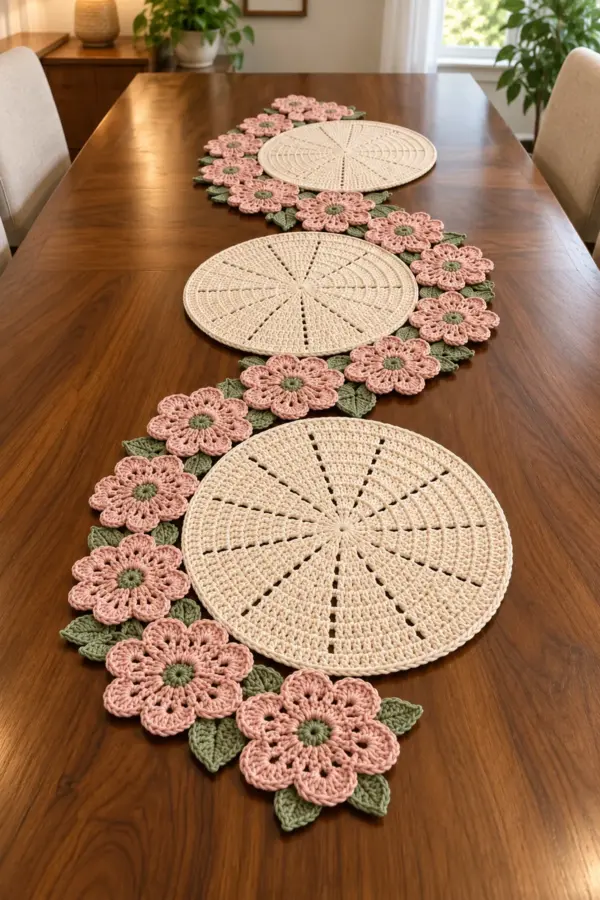
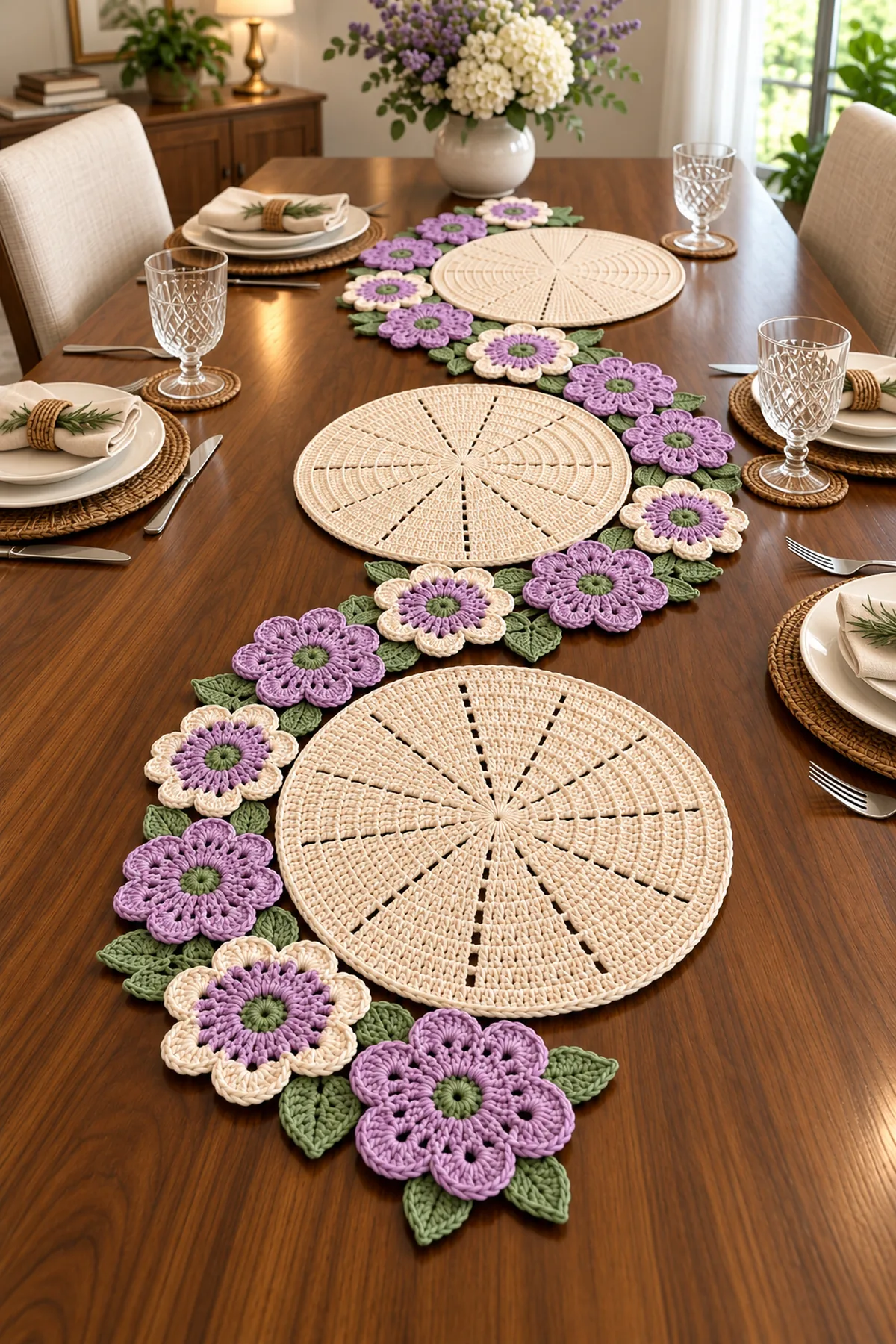
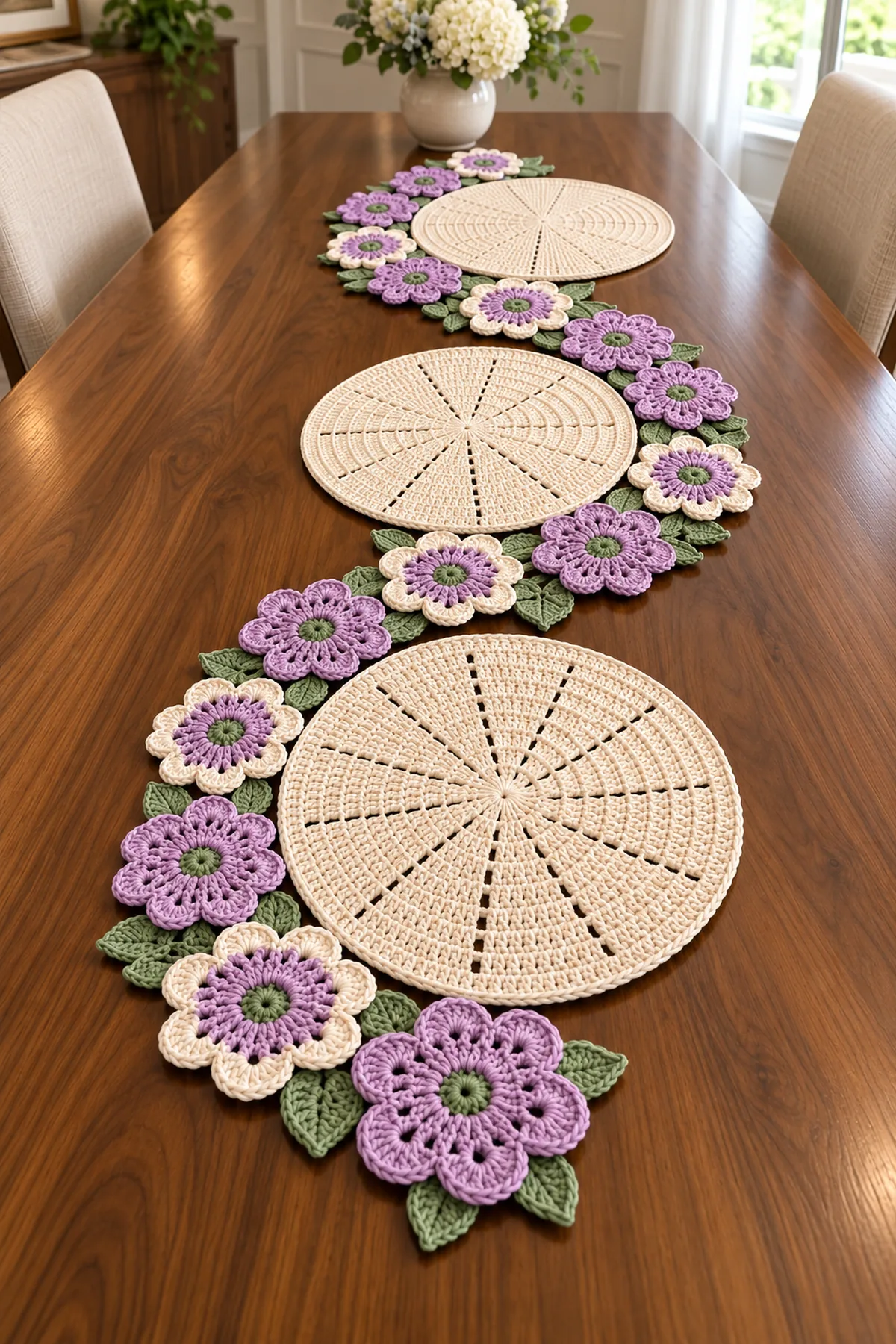
This Lavender & Ivory Floral Crochet Table Runner & Matching Placemat Set follows the supplied photo as a coordinated four-piece arrangement, not one solid runner. Three matching ivory circular placemats form the large neutral focal points. Beneath and around them, a separate lavender, ivory, and sage floral garland curves down the center of the table without a rectangular backing. Nine solid lavender flowers alternate with six two-tone ivory-and-lavender flowers, while thirty pointed sage leaves keep the wooden tabletop visible and preserve the airy botanical silhouette of the reference design.
Thank you for reading this post, don't forget to subscribe!Crochet the three placemats first from identical twelve-stitch center rings. Maintain twelve wedge sectors through every round and align one eyelet spoke in every sector. Make fifteen sage centers, complete nine with solid lavender petals, and complete six with ivory outer petals plus a smaller lavender inner layer. Crochet thirty matching veined leaves. Block every component separately, join the fifteen flower-and-leaf units into one gently winding open garland, and keep the three placemats separate so they can be centered over it at evenly spaced settings.
Why You’ll Love This Project
The set combines practical washable placemats with an independent floral runner that can also be displayed alone. The restrained ivory, lavender, and sage palette feels fresh and elegant, while alternating solid and two-tone blossoms gives the garland a clear rhythm. Because the placemats are not attached, the four pieces can be rearranged for different tables and stored flat in separate layers.
Materials
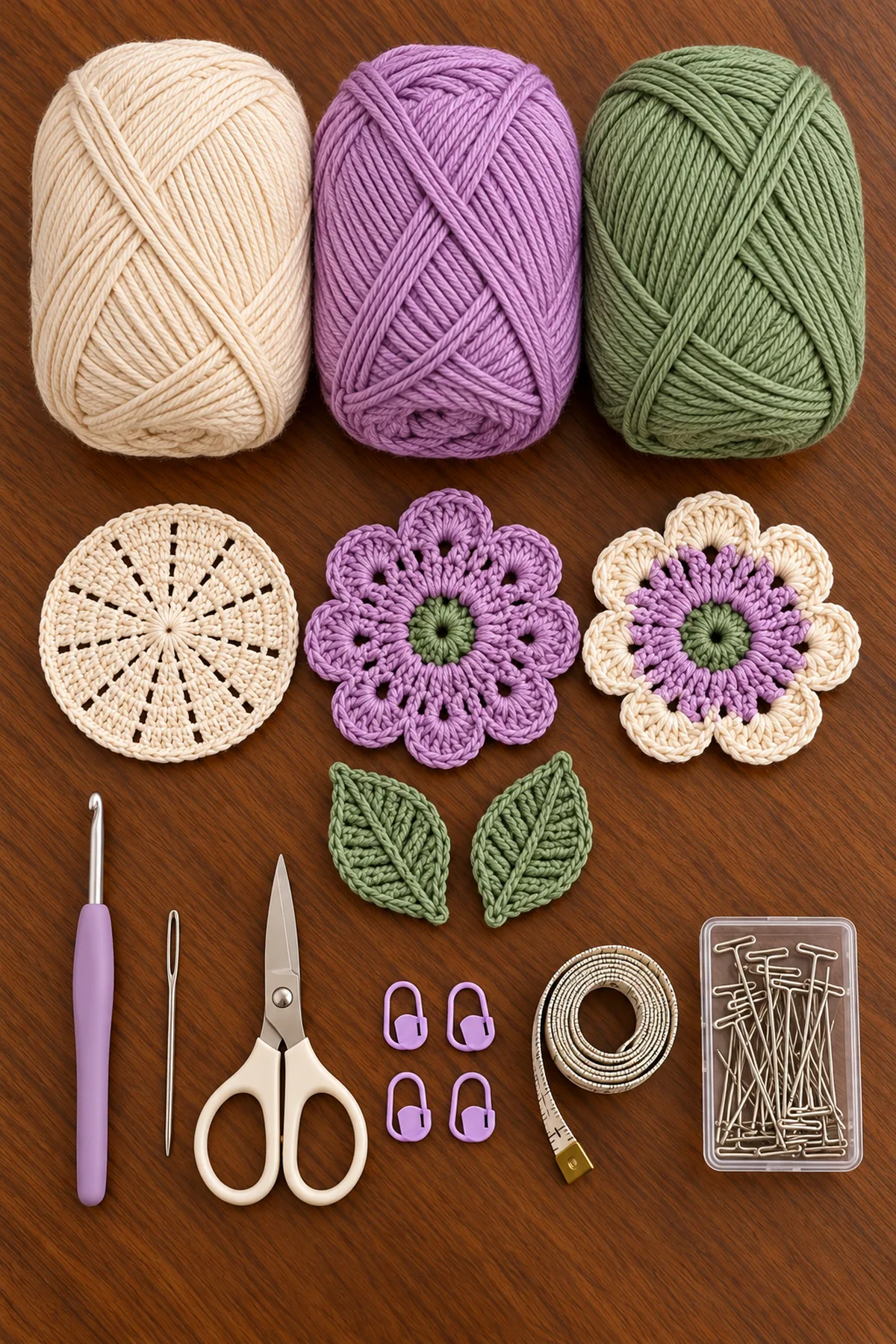
- About 1,180 yards warm-ivory DK cotton or cotton-blend yarn for three round placemats and six sets of outer flower petals
- About 540 yards soft-lavender DK cotton for nine solid flowers and six inner petal layers
- About 330 yards muted sage-green DK cotton for fifteen flower centers, thirty leaves, and hidden joining bridges
- 3.5 mm crochet hook
- Yarn needle, scissors, locking stitch markers, tape measure, blocking mats, and rustproof pins
- Optional transparent non-slip table mat placed beneath the separate set during use
Gauge, Measurements, and Planning
Block the first placemat after Round 12 and verify a 15-inch diameter with all twelve sectors flat. If the circle cups, add one small increase in every sector on the next solid round; if it ruffles, omit one increase per sector. A blocked outer flower should measure about 4 inches across and one leaf about 3.5 inches long. Arrange all fifteen flowers on a 72-inch paper guide before joining.
Make and wash a gauge swatch before beginning. Measure only after the swatch is completely dry. If the stitch width differs, change hook size rather than pulling the working yarn tighter. Keep a written count at the end of every section so the finished edges remain balanced and the assembly points line up.
Abbreviations and Special Stitches
- ch: chain
- sc: single crochet
- hdc: half double crochet
- dc: double crochet
- tr: treble crochet
- sl st: slip stitch
- sp: space
- st(s): stitch(es)
- inc: increase
Special stitch guidance: Radial eyelet spoke: ch 1 over the marked spoke position while placing the round’s required increase in the adjacent solid stitches. Open outer petal: around one chain foundation work sc, hdc, 3 dc, 2 tr, 3 dc, hdc, sc, then anchor to the next center space. Smaller inner petal: work sc, hdc, 3 dc, hdc, sc around the front-loop chain of one completed outer petal. Veined leaf: mirror graduated stitches around both sides of a foundation chain, then surface-slip-stitch from base to pointed tip. Hidden joining bridge: chain between motif backs in sage and tack only through back loops so the front remains open.
Before You Begin
- Make exactly three identical warm-ivory round placemats and keep them separate from the floral runner.
- Every placemat maintains exactly twelve radial wedge sectors and twelve aligned eyelet spokes.
- The runner is an open garland with no solid, filet, mesh, rectangular, oval, or fabric backing.
- Make exactly fifteen flowers with one sage center and eight rounded outer petals each: nine solid lavender and six with ivory outer petals plus a smaller lavender inner layer.
- Make exactly thirty sage leaves and place two beneath each flower.
- Arrange the three placemats at evenly spaced points over the finished garland; never stitch them to the flowers or leaves.
Instructions
Crochet Three Twelve-Sector Ivory Placemats
Use the first completed circle as the size and spoke-position template for the other two.
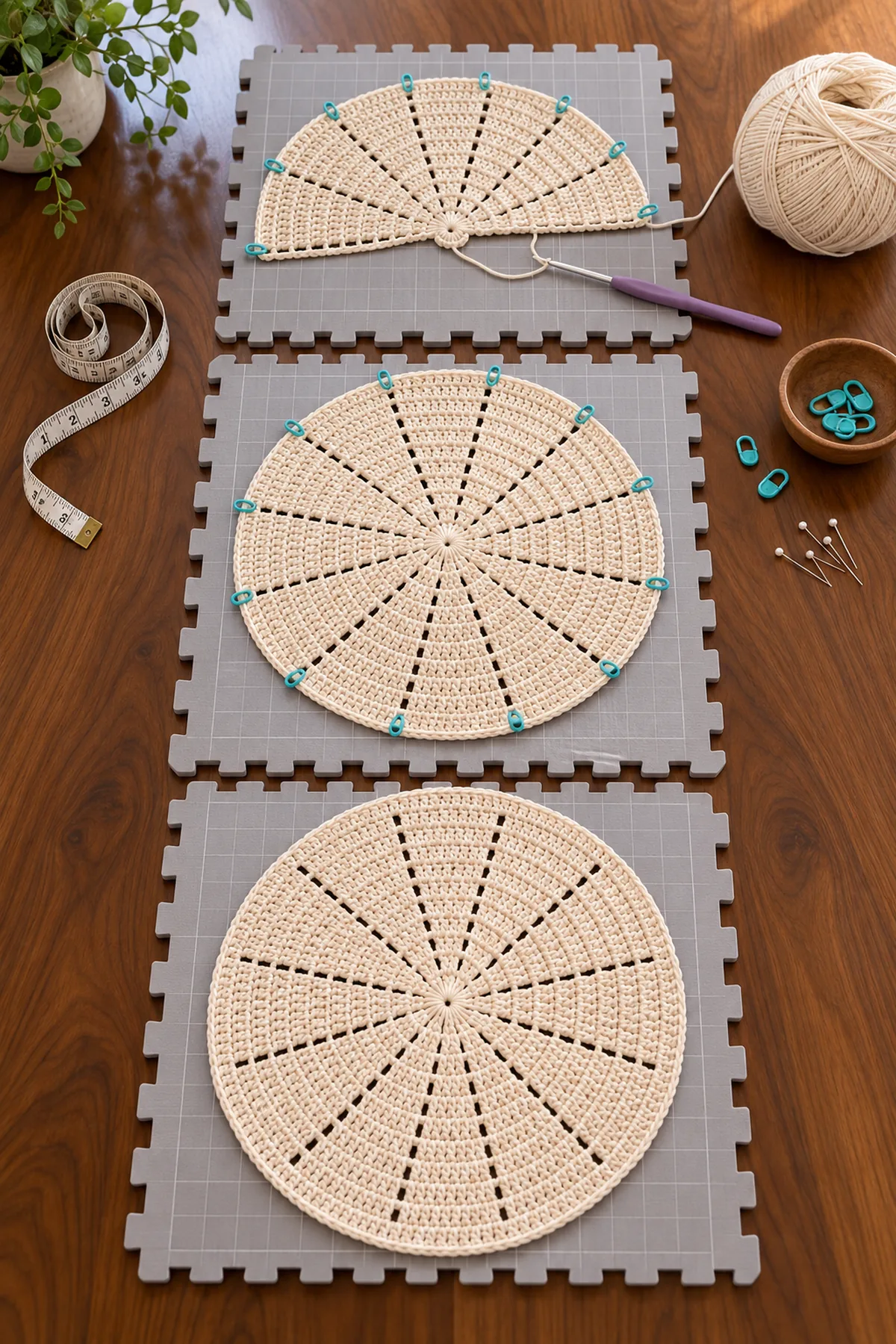
- Round 1: With warm ivory, make a magic ring and work 12 dc into it. Join and place one marker in every stitch to identify twelve sectors. (12 sts)
- Round 2: Ch 3, work 2 dc in each stitch around, and join. (24 sts)
- Round 3: Repeat [dc in next stitch, 2 dc in next stitch] around. Join. (36 sts)
- Rounds 4–12: Increase by twelve stitches on each solid round, keeping one increase inside every marked sector. On alternating rounds, form one ch-1 eyelet at the same edge of each sector so twelve narrow spokes radiate from the center. Stagger increase positions between spokes to keep the circle flat.
- Finish with one round of hdc and one firm sc round without scallops. Block to 15 inches in diameter, preserving twelve equal wedges. Make exactly three matching placemats.
Make Nine Solid Lavender Eight-Petal Flowers
Keep the sage center and eight-petal count identical on all nine motifs.
- For each flower center, with sage make a magic ring and work 8 sc. Join. (8 sts)
- Round 2: Work 2 sc in each stitch around. Join. (16 sts)
- Change to lavender. Repeat [sl st in next stitch, ch 9, skip next stitch] around to form exactly eight petal foundations.
- Around each chain-9 foundation work sc, hdc, 3 dc, 2 tr, 3 dc, hdc, sc; slip stitch into the next sage stitch before the following petal.
- Fasten off, spread the eight rounded petals, and block to approximately 4 inches. Make exactly nine solid lavender flowers.
Make Six Two-Tone Flowers and Thirty Sage Leaves
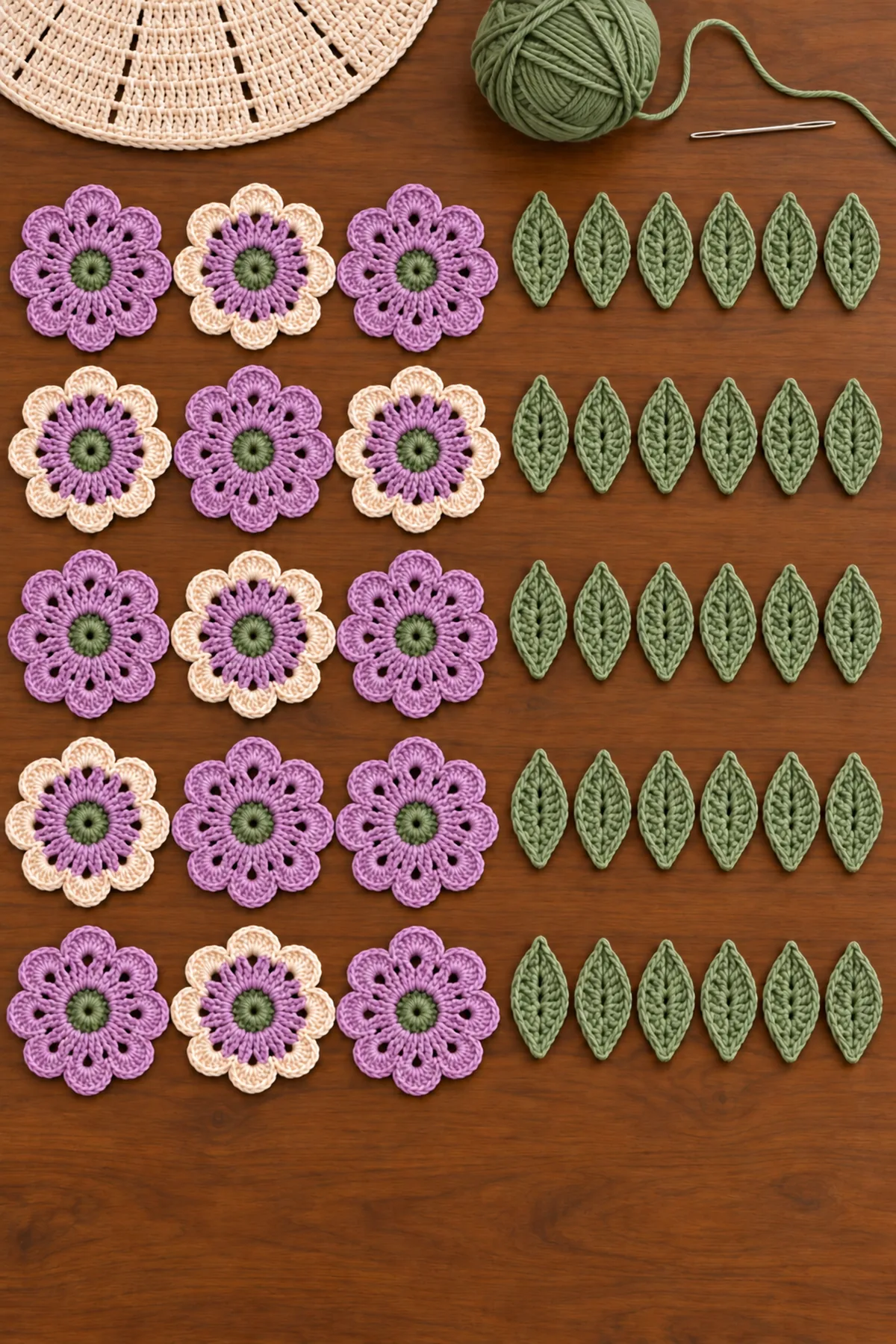
The ivory outer petals and smaller lavender inner petals reproduce the alternating blossoms in the supplied design.
- Make six sage centers exactly as for the solid flowers, ending with 16 stitches.
- With ivory, add exactly eight chain-9 foundations and work one full open outer petal around each foundation.
- Join lavender to the front-loop base of every ivory petal. Work one smaller petal of sc, hdc, 3 dc, hdc, sc over each inner chain, giving every motif eight lavender inner petals framed by eight ivory outer petals.
- For each leaf, with sage ch 13. Beginning in the second chain, work sl st, sc, hdc, 6 dc, hdc, sc, sl st; ch 2 at the tip and mirror the sequence down the other side.
- Surface-slip-stitch along the leaf center from base to tip. Block to 3.5 inches. Make exactly thirty leaves and sort them into fifteen pairs.
Assemble the Open Garland and Arrange the Set
Join only the flower-and-leaf units; keep all three placemats independent.
- On a 72-inch paper guide, arrange all fifteen flowers in one gently winding line, alternating solid lavender and two-tone motifs while keeping nine solid and six layered flowers in total.
- Tuck one pair of sage leaves beneath every flower and angle the points outward. Keep the two end clusters fuller, as shown in the supplied reference.
- From the wrong side, connect adjacent flower centers with short sage chain bridges. Tack bridges to nearby leaf bases without trapping petals or leaf tips.
- Reinforce both end clusters and every fifth flower with a second hidden bridge. Block the complete open garland to approximately 14 by 72 inches without adding any background.
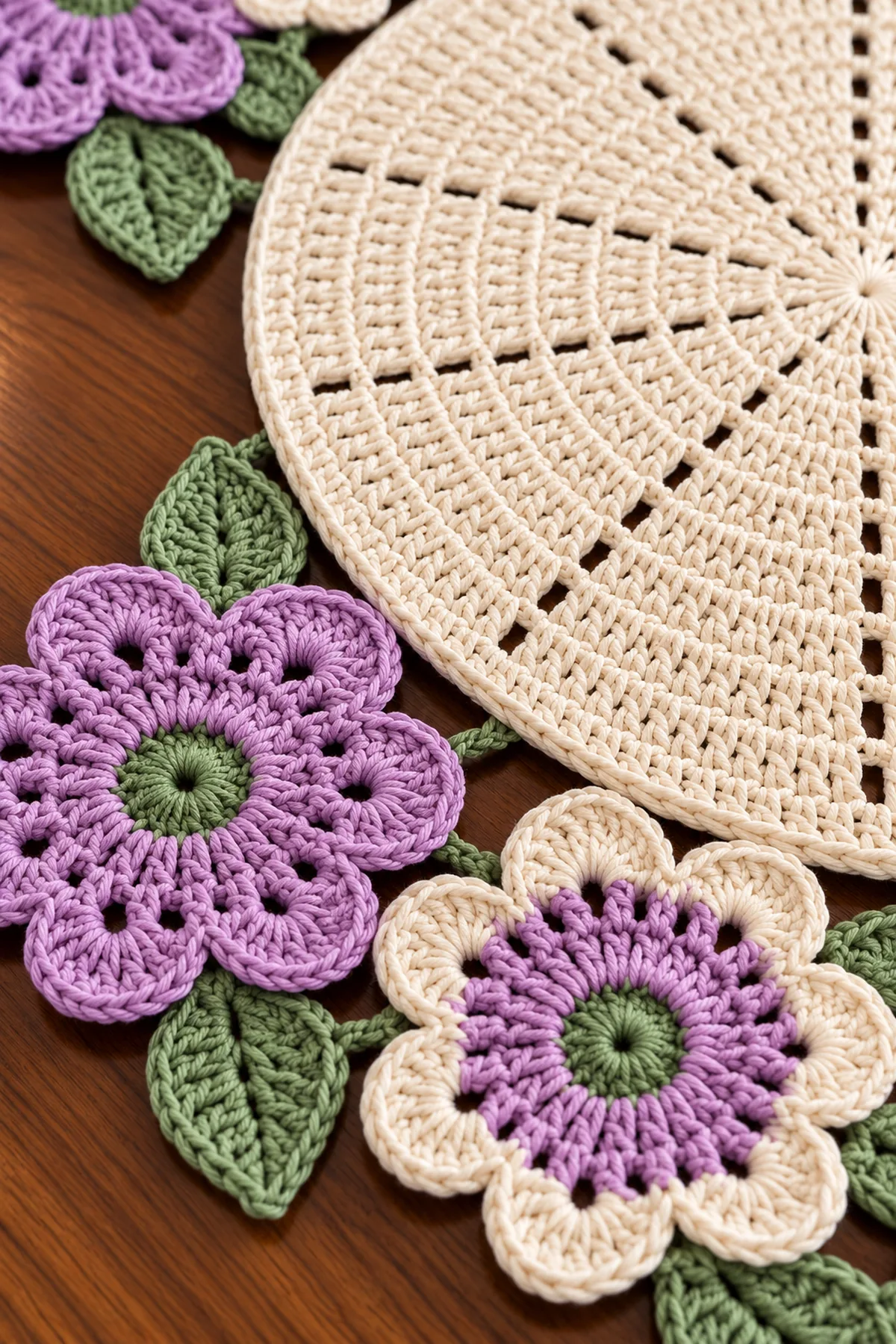
- Center the garland lengthwise on the table. Place one ivory placemat near each end and one at the midpoint, evenly spaced over the garland so lavender, ivory, and sage motifs remain visible along both sides. Do not sew the circles to the runner.
Assembly and Shaping
Block the three ivory circles, nine solid lavender flowers, six ivory-and-lavender layered flowers, and thirty sage leaves separately. Pair two leaves with every flower, then alternate the two flower styles along one gently winding centerline and join the fifteen units with hidden sage bridges. Keep the tabletop visible between motifs and make the end clusters slightly fuller. Center three separate placemats at equal intervals over the floral garland without attaching them.
Lay every component on a flat surface before joining. Match the marked centers first, then divide each remaining edge into equal sections. Work through both layers with consistent tension and pause after each section to check that the fabric lies flat. This measured approach prevents twisting and keeps decorative details facing the intended direction.
Finishing
- Weave ivory tails through solid placemat rounds rather than through eyelet spokes.
- Hide lavender and ivory flower tails behind their matching petal anchors and sage tails along the raised leaf veins.
- Reinforce every fifth floral join and both end clusters from the wrong side.
- Steam petals and leaves lightly without flattening the raised centers, inner layers, or veins.
- Store the garland loosely rolled and stack the three placemats flat between clean towels.
For a polished result, weave each tail through several same-color stitches, reverse direction once, and trim only after the fabric has been gently stretched. Block to the listed dimensions without flattening textured stitches. Inspect joins, borders, straps, and decorative pieces before the project is used or gifted.
Helpful Tips
- Count all twelve placemat sectors at the end of every round.
- Make and block one solid flower and one two-tone flower before producing the remaining motifs.
- Photograph the full pinned garland before joining so the alternating flower rhythm and gentle curve remain accurate.
- Use transparent non-slip matting beneath the set if the table surface is very smooth.
Good lighting and a contrasting stitch marker make counting much easier. If a section looks uneven, compare the current count with the previous checkpoint before continuing. Fixing one missed stitch early is faster than compensating later, and it preserves the measurements used by the assembly instructions.
Frequently Asked Questions
Are the placemats sewn to the runner?
No. The supplied design uses three separate ivory circles placed over one independent open floral garland.
How many flowers and leaves are required?
Make fifteen flowers—nine solid lavender and six ivory-and-lavender layered motifs—plus thirty sage leaves, two per flower.
Why is my placemat ruffling?
Too many increases were added. Keep exactly twelve sectors and distribute only one planned increase in each sector on the next solid round.
Can I add a fabric or mesh backing?
Not for this design. Its defining silhouette comes from the open flower-and-leaf garland with the tabletop visible.
Conclusion
Three matching ivory twelve-sector placemats, nine solid lavender flowers, six ivory-and-lavender layered flowers, fifteen sage centers, and thirty pointed sage leaves reproduce the coordinated table arrangement shown in the supplied photo. Keeping the garland open and the circles separate preserves both its botanical silhouette and its practical flexibility.
Printable Crochet Pattern Card
Project: Lavender & Ivory Floral Crochet Table Runner & Matching Placemat Set
Skill level: Intermediate Hook: 3.5 mm Yarn: DK
Finished size: Each placemat approximately 15 inches in diameter; floral garland approximately 14 inches wide by 72 inches long
Card Materials
- About 1,180 yards warm-ivory DK cotton or cotton-blend yarn for three round placemats and six sets of outer flower petals
- About 540 yards soft-lavender DK cotton for nine solid flowers and six inner petal layers
- About 330 yards muted sage-green DK cotton for fifteen flower centers, thirty leaves, and hidden joining bridges
- 3.5 mm crochet hook
- Yarn needle, scissors, locking stitch markers, tape measure, blocking mats, and rustproof pins
- Optional transparent non-slip table mat placed beneath the separate set during use
Card Instructions
- Crochet Three Twelve-Sector Ivory Placemats: Make three identical 15-inch ivory circles with twelve radial sectors, twelve aligned eyelet spokes, and a firm plain edge.
- Make Nine Solid Lavender Eight-Petal Flowers: Crochet nine solid lavender flowers, each with one sage center and exactly eight open rounded petals.
- Make Six Two-Tone Flowers and Thirty Sage Leaves: Make six ivory-and-lavender layered flowers and thirty pointed sage leaves, grouped as two leaves per flower.
- Assemble the Open Garland and Arrange the Set: Join fifteen flower-and-two-leaf units into one open 72-inch garland, then place three separate ivory placemats evenly over it.
Finish: Check every count, weave in all ends, block to measurement, and inspect each join.