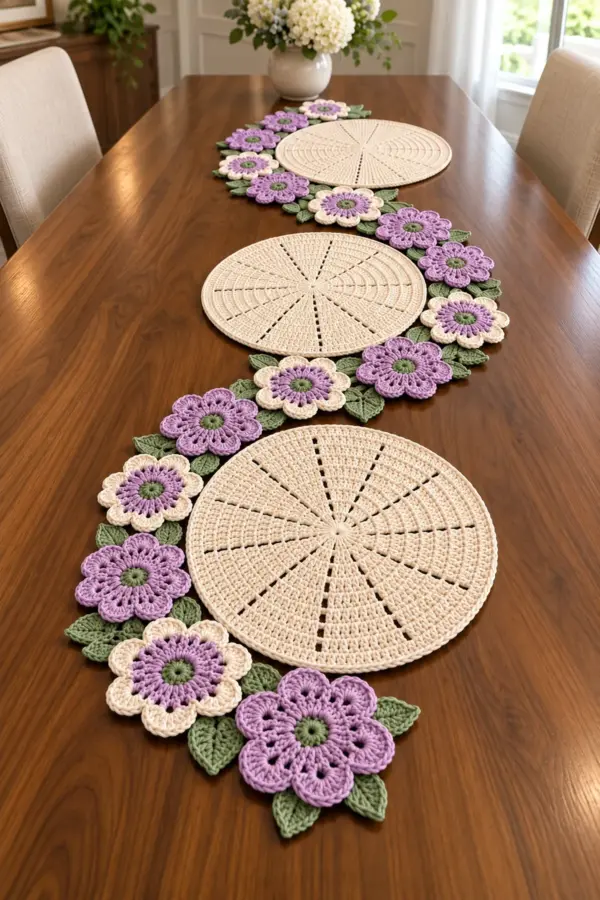
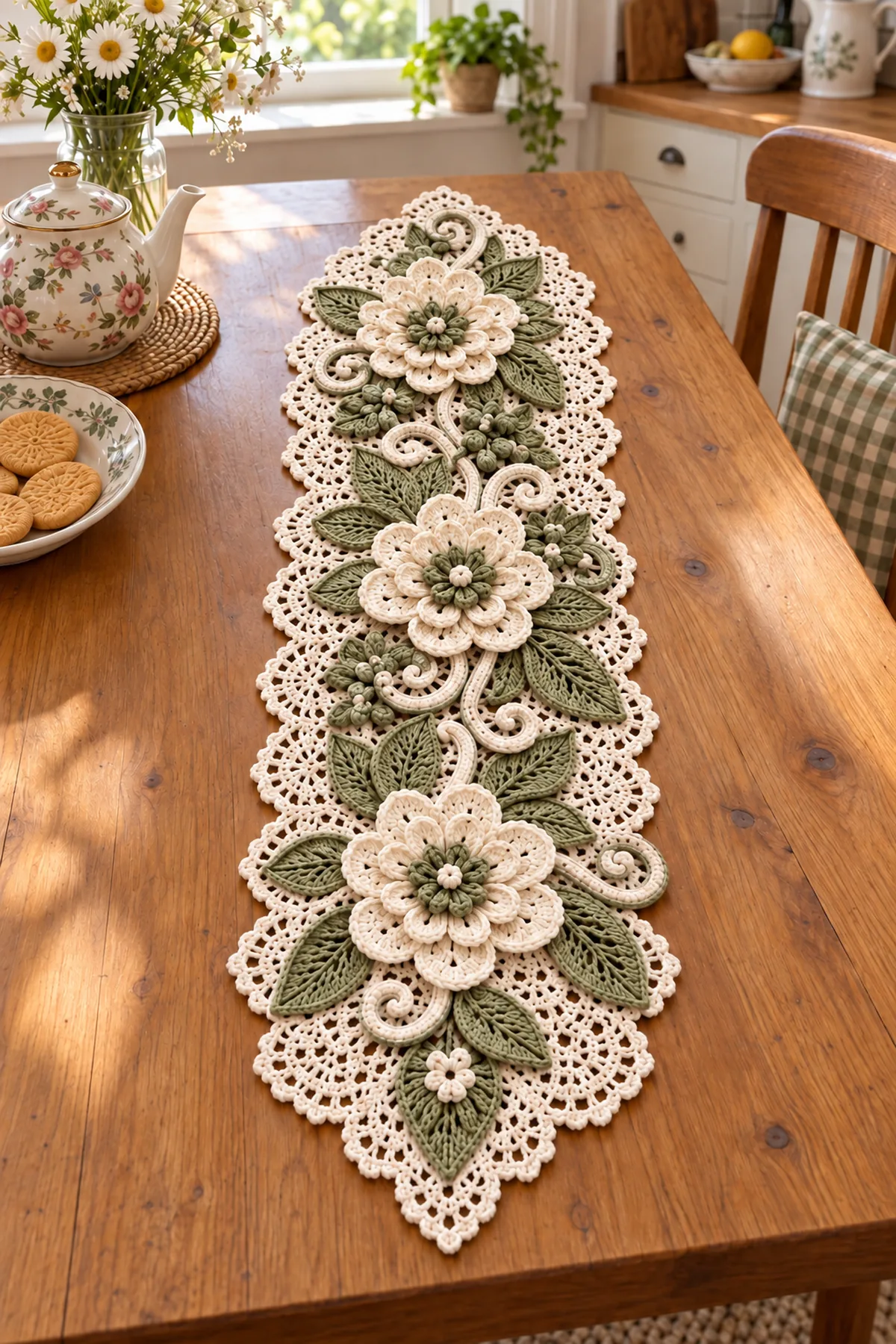
This Floral Lace Table Runner Pattern combines delicate ivory crochet with a quiet sage-green garden. Three overlapping oval lace panels create a long centerpiece, while one dimensional ivory flower marks each panel. Ribbed leaves, curling tendrils, and clusters of tiny crochet buds give the runner the graceful movement of the inspiration image.
Thank you for reading this post, don't forget to subscribe!The design is made in manageable parts. Work and block all three ivory panels first, join their short ends, and then arrange the botanical motifs. That sequence keeps the lace flat and lets you balance the three flowers before stitching them in place.
Why You’ll Love This Floral Runner
The repeating center panels are easy to track with markers, yet the finished runner looks richly detailed. Ivory petals against muted sage centers and leaves suit a farmhouse dining table, a tea setting, or a handmade wedding display. Every decorative element is crocheted; no purchased floral trim is needed.
Pattern Details
- Skill level: Advanced intermediate
- Hook: 3.25 mm
- Yarn: Sport-weight mercerized cotton
- Finished size: Approximately 14 inches wide by 52 inches long
- Gauge: 21 dc and 11 rows equal 4 inches in the solid sample
- Terminology: US crochet terms
- Estimated time: 22–26 hours
Materials
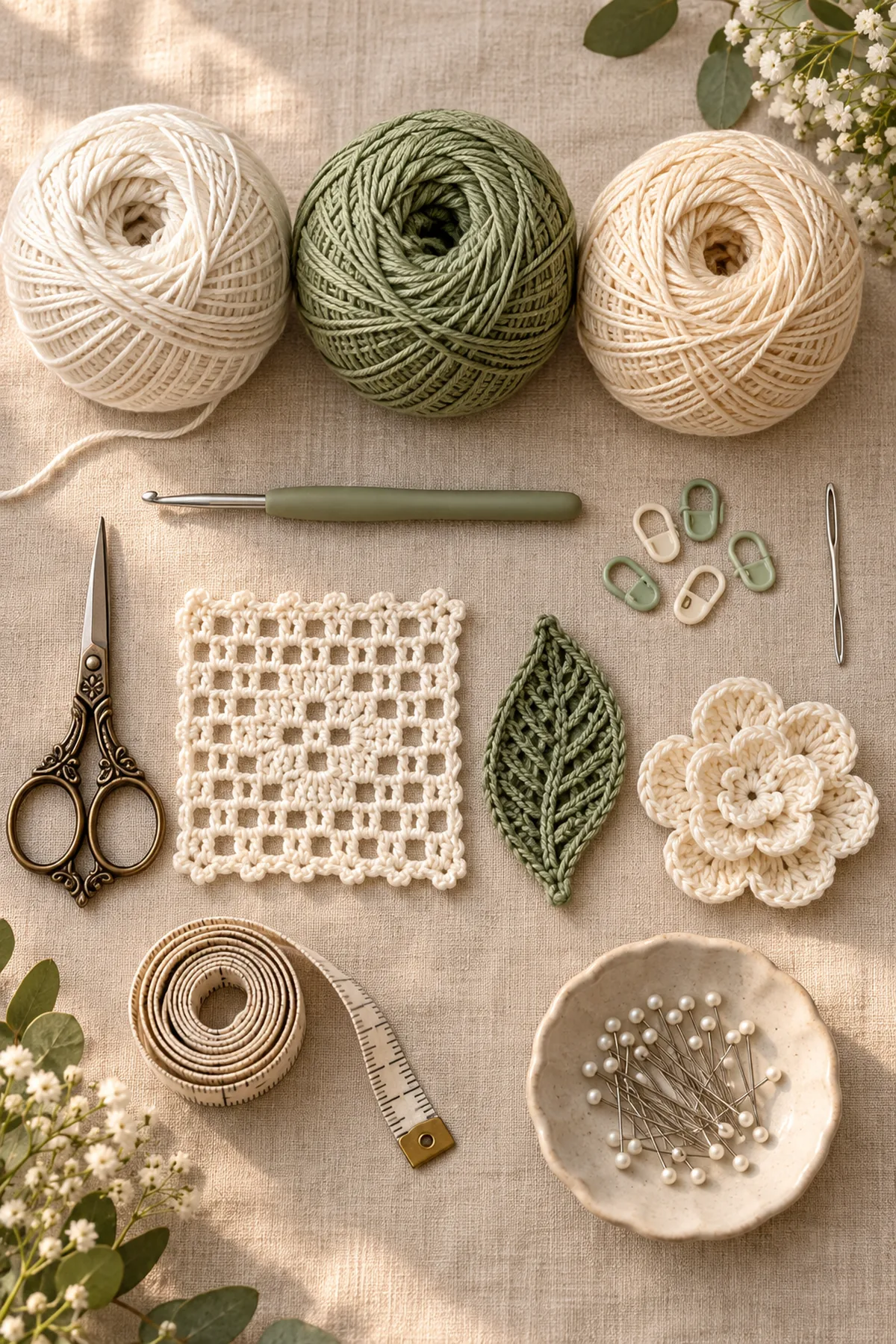
- 900 yards ivory sport-weight mercerized cotton
- 310 yards muted-sage sport-weight mercerized cotton
- 55 yards warm-cream sport-weight mercerized cotton
- 3.25 mm crochet hook
- Twenty locking stitch markers
- Yarn needle, scissors, tape measure, blocking mats, and rustproof pins
Gauge, Measurements, and Layout
A panel begins with 34 double crochet and measures about 20 inches long after the 55-row center and oval edging are blocked. Make three matching panels, then overlap neighboring short ends by 4 inches; two overlaps produce a runner near 52 inches long. The inner filet strip measures about 6.5 inches across, with wide lace fans bringing the blocked width near 14 inches.
Each panel receives one large ivory flower with a sage center, four ribbed sage leaves, three curling scrolls, and six small sage buds. The finished runner therefore has exactly three large flowers, twelve leaves, nine scrolls, and eighteen buds.
Abbreviations and Special Stitches
- ch: chain
- dc: double crochet
- hdc: half double crochet
- sc: single crochet
- sl st: slip stitch
- tr: treble crochet
- st(s): stitch(es)
- sp: space
Filet square: Ch 2, skip 2 stitch positions, dc in the next stitch.
Open fan: Dc, ch 2, dc in the same space.
Scallop shell: Work 7 dc in one chain space.
Layered petal: Sc, hdc, 3 dc, tr, 3 dc, hdc, sc in one space.
Before You Begin
- Beginning chains do not count as stitches unless stated.
- Mark the first five and final five positions of every filet row.
- Make one full panel and check its blocked dimensions before repeating it twice.
- Attach the flowers only after both overlaps have been sewn and blocked again.
Floral Lace Table Runner Pattern Instructions
Make Three Matching Filet Panels
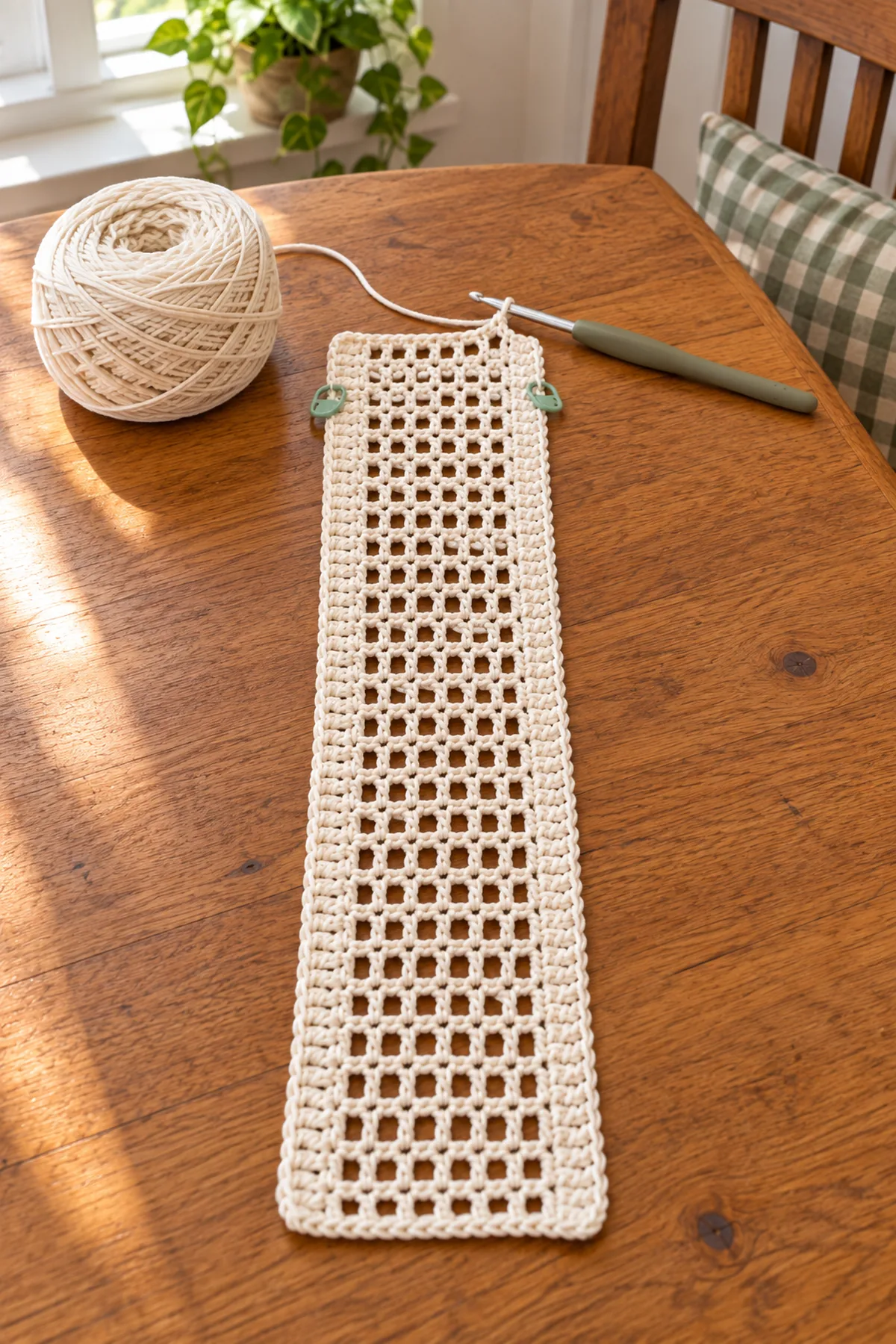
- Foundation Row: Ch 37. Dc in the fourth chain from the hook and in every remaining chain. Turn. (34 sts)
- Row 2: Ch 3, dc in every stitch across. Turn. (34 sts)
- Row 3: Ch 3, dc in the first five stitches; repeat [ch 2, skip two positions, dc in next stitch] eight times; dc in the final five stitches. Turn. (34 sts)
- Rows 4–53: Preserve the five-dc rail at each edge. Over the middle 24 positions, work dc above each prior dc and ch 2 across each prior chain-2 space. Turn after every row and count 34 positions.
- Rows 54–55: Ch 3 and work dc across all 34 positions, placing two dc in each chain-2 space. Turn after Row 54 and fasten off after Row 55. (34 sts)
- Repeat the complete 55-row strip twice more, checking all three lengths before adding lace.
Shape the Oval Lace Around Each Strip
- Join ivory at the center of one long edge. Work one round of evenly spaced sc around the strip, placing three sc in each corner. Join without turning.
- On both long edges, repeat [ch 4, skip three edge stitches, sc in next edge stitch]. At the short ends, use chain-3 arches spaced over two edge stitches so the curves stay smooth.
- Work an open fan in every chain arch on the next round. Add a second open fan into every other arch near the midpoint of each short end to round the oval.
- Work a seven-dc scallop shell in each fan space. On the narrowest end curves, use five-dc shells to keep the border flat.
- Finish with [sc in next shell center, ch 3, sl st in first chain] around the outside. Fasten off and block each panel to matching measurements.
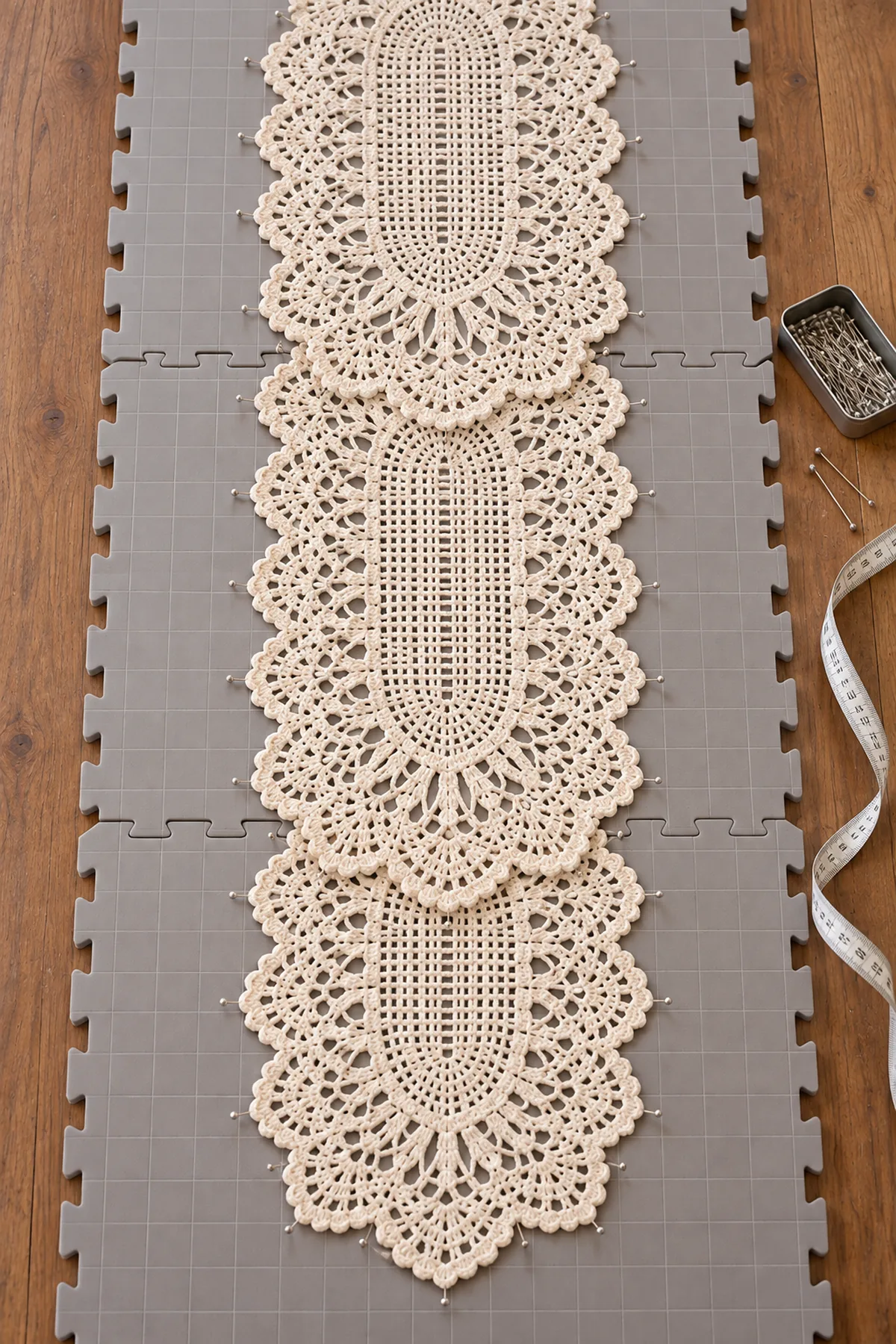
Join the Three Panels
- Lay the blocked panels end to end with the middle panel overlapping each outer panel by 4 inches.
- Keep all three long axes straight and pin both overlaps through solid inner rails, not through open fan spaces.
- With ivory yarn, whipstitch each overlap through the back loops of solid stitches.
- Add a second concealed line of slip stitches across the back of each join. Reblock the joined base to about 14 by 52 inches.
Make Three Layered Ivory Flowers
- With sage, make a magic ring and work 12 puff stitches into the ring. Join for the raised flower center.
- Join warm cream behind the center and form eight chain-4 spaces. Work one layered petal in each space.
- Join ivory behind the first layer and form eight chain-6 spaces. Work sc, hdc, 3 dc, tr, 3 dc, hdc, sc in every chain-6 space.
- Add an outer ivory layer using eight chain-8 spaces and broad petals made from sc, hdc, 5 dc, 2 tr, 5 dc, hdc, sc.
- Fasten off with a long sewing tail. Make two more identical flowers.
Make Twelve Sage Leaves
- Ch 17. Sl st in second chain, then work sc, hdc, 10 dc, hdc, sc, and sl st along one side.
- Repeat the mirrored sequence along the underside of the foundation chain.
- Work reverse sc around the outside and surface-slip-stitch over the center chain for a raised vein.
- Fasten off with a sewing tail and repeat until twelve leaves are complete.
Make Nine Scrolls and Eighteen Buds
- For each scroll, ch 35 in sage. Work two sc in every second chain from the hook; the increasing stitches turn the strip into a soft curl.
- Hold the strip against the lace and tack the inner edge at three points so the curl remains raised. Make nine scrolls.
- For each bud, make a magic ring, work five small bobble stitches into it, draw the ring closed, and add a chain-5 stem.
- Make eighteen buds and leave long tails for attaching them among the leaves and scrolls.
Arrange the Botanical Clusters
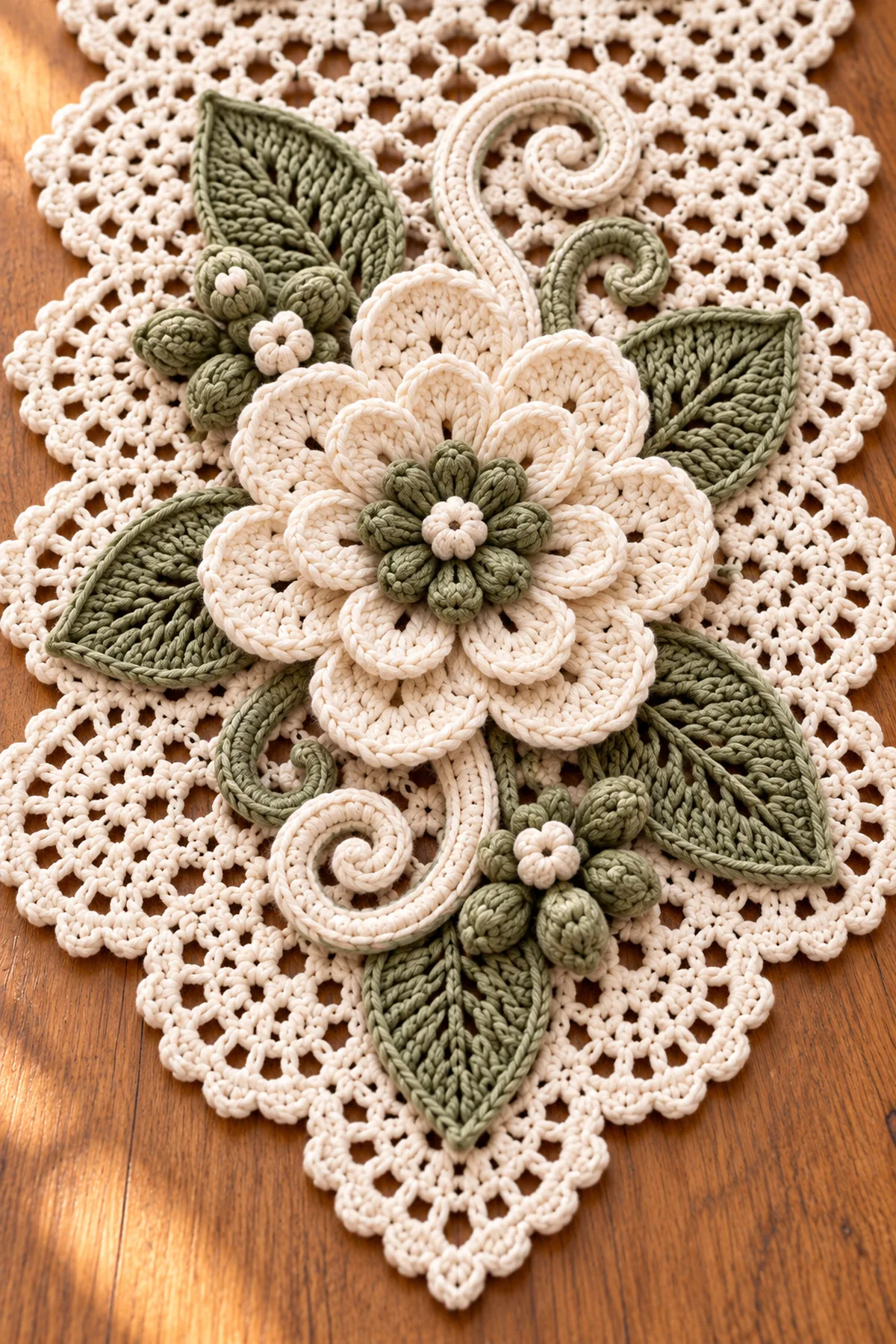
- Center one flower on each oval panel. Angle four leaves around every flower so their points remain visible.
- Place three scrolls around every flower, with one curling toward a neighboring panel to visually connect the three groups.
- Distribute six buds around each flower, varying their stem direction but preserving an even total along both sides.
- Photograph the arrangement, then sew leaves and buds first, scrolls second, and flowers last through their firm centers and lower petal bases.
Assembly and Shaping
Check the runner from both ends before the final flower is secured. The middle flower should sit on the long axis while the outer flowers mirror one another. Let several sage scrolls overlap the joins so the three panels read as one continuous floral piece, but leave most of the ivory lace visible.
Finishing
- Weave ivory tails through dense rails rather than across filet openings.
- Hide sage tails under leaf veins, bud stems, or the backs of scrolls.
- Mist-block the completed runner, reopening every ivory scallop and picot with rustproof pins.
- Lift the outer flower petals with your fingers while the runner dries flat. Check both panel joins before use.
Helpful Tips
- Keep the same hook and yarn tension across all three panels so their ovals match.
- Make a 4-inch overlap template from scrap card to position both joins identically.
- Use mercerized cotton to emphasize the openwork and leaf veins.
- Place scrolls on the runner before sewing; each curl may relax in a different direction.
- Hand-wash in cool water, support the runner at both joins when lifting, and dry flat.
Frequently Asked Questions
Can I make a shorter runner?
Yes. Use two oval panels and one measured 4-inch overlap. Place one flower on each panel and reduce the leaves, scrolls, and buds proportionally.
Can I change the sage yarn?
Soft eucalyptus, dusty blue, or muted olive can replace sage while preserving the ivory lace and layered flower construction.
Why are the oval borders rippling?
The long edges may have too many arches or the short ends may have too many increases. Remove one arch in the rippled area, then block the panel before continuing.
Conclusion
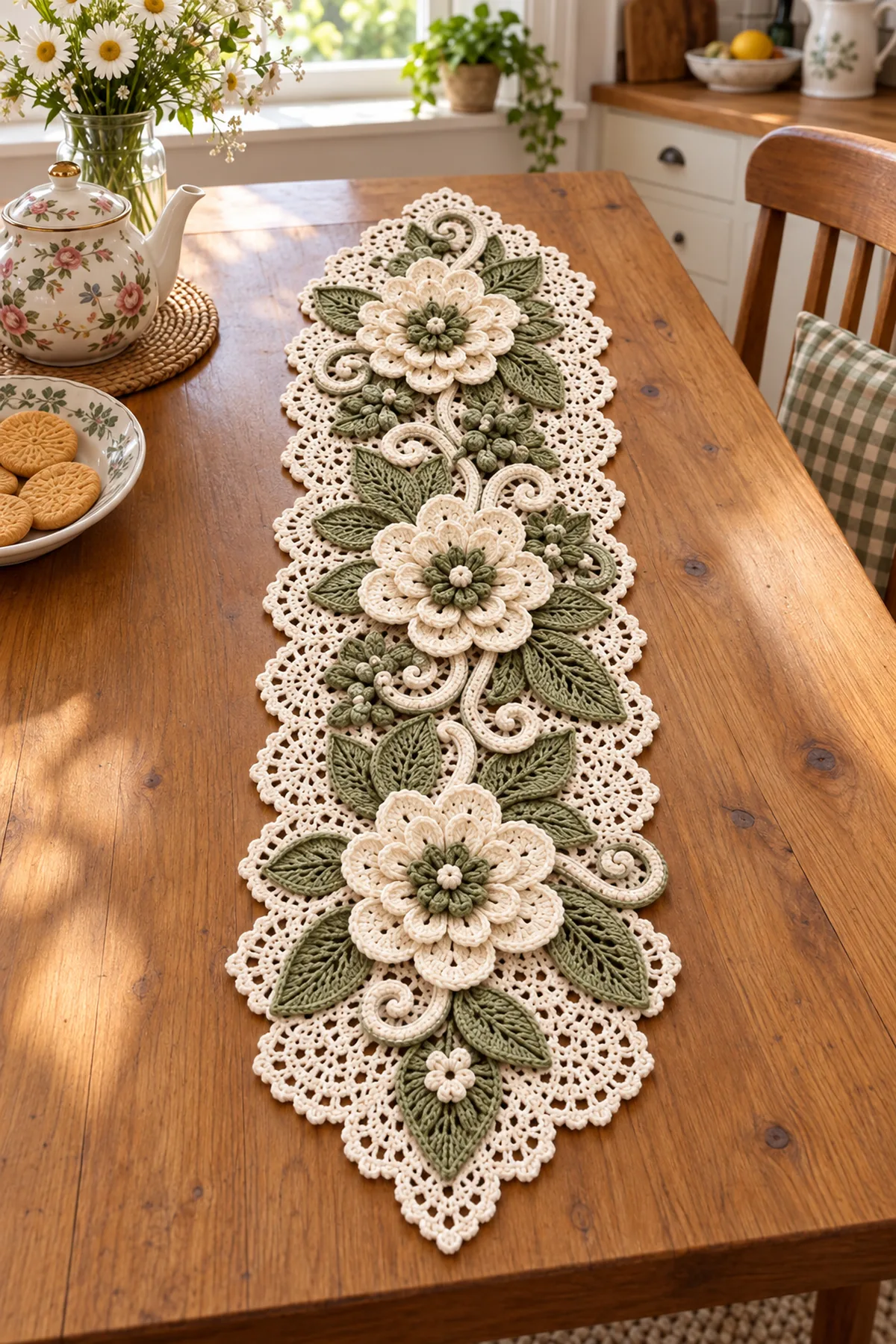
The completed floral lace table runner brings together three light ivory ovals, three dimensional flowers, textured sage foliage, and graceful scrollwork. Its balanced modular construction produces an elegant centerpiece while keeping each stage small enough to count, block, and finish carefully.
Printable Crochet Pattern Card
Project: Floral Lace Table Runner Pattern
Skill level: Advanced intermediate Hook: 3.25 mm Yarn: Sport cotton
Finished size: Approximately 14 inches wide by 52 inches long
Card Materials
- Ivory, muted-sage, and warm-cream sport-weight cotton
- 3.25 mm hook, markers, needle, scissors, tape measure, and blocking supplies
Card Instructions
- Panels: Make three 34-position, 55-row ivory filet strips.
- Lace: Shape each strip with oval fans, scallop shells, and picots.
- Join: Block and overlap the three ovals by 4 inches at both joins.
- Flowers: Make three layered ivory flowers with sage centers.
- Foliage: Add twelve ribbed sage leaves, nine scrolls, and eighteen crochet buds.
- Finish: Sew the motifs securely, reopen the lace, and block flat.