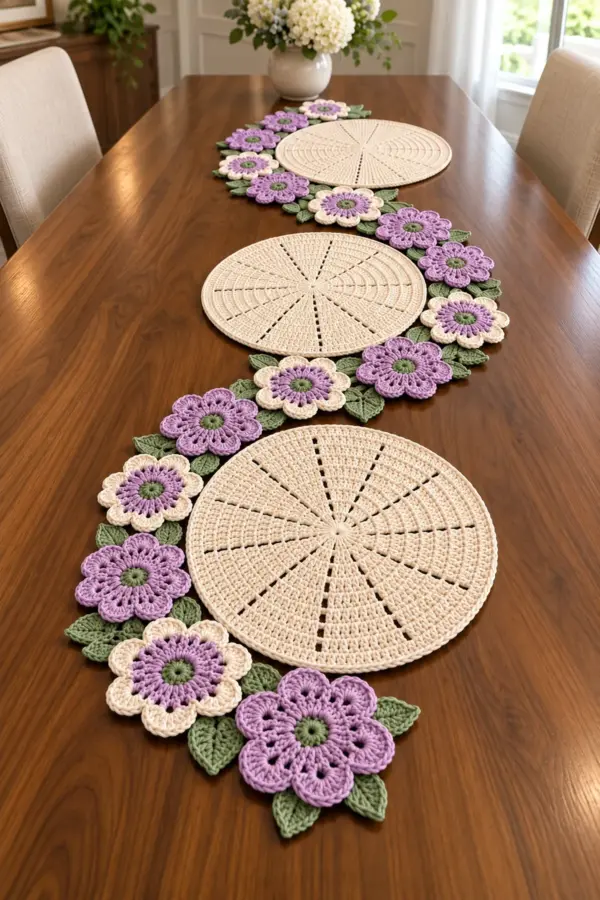
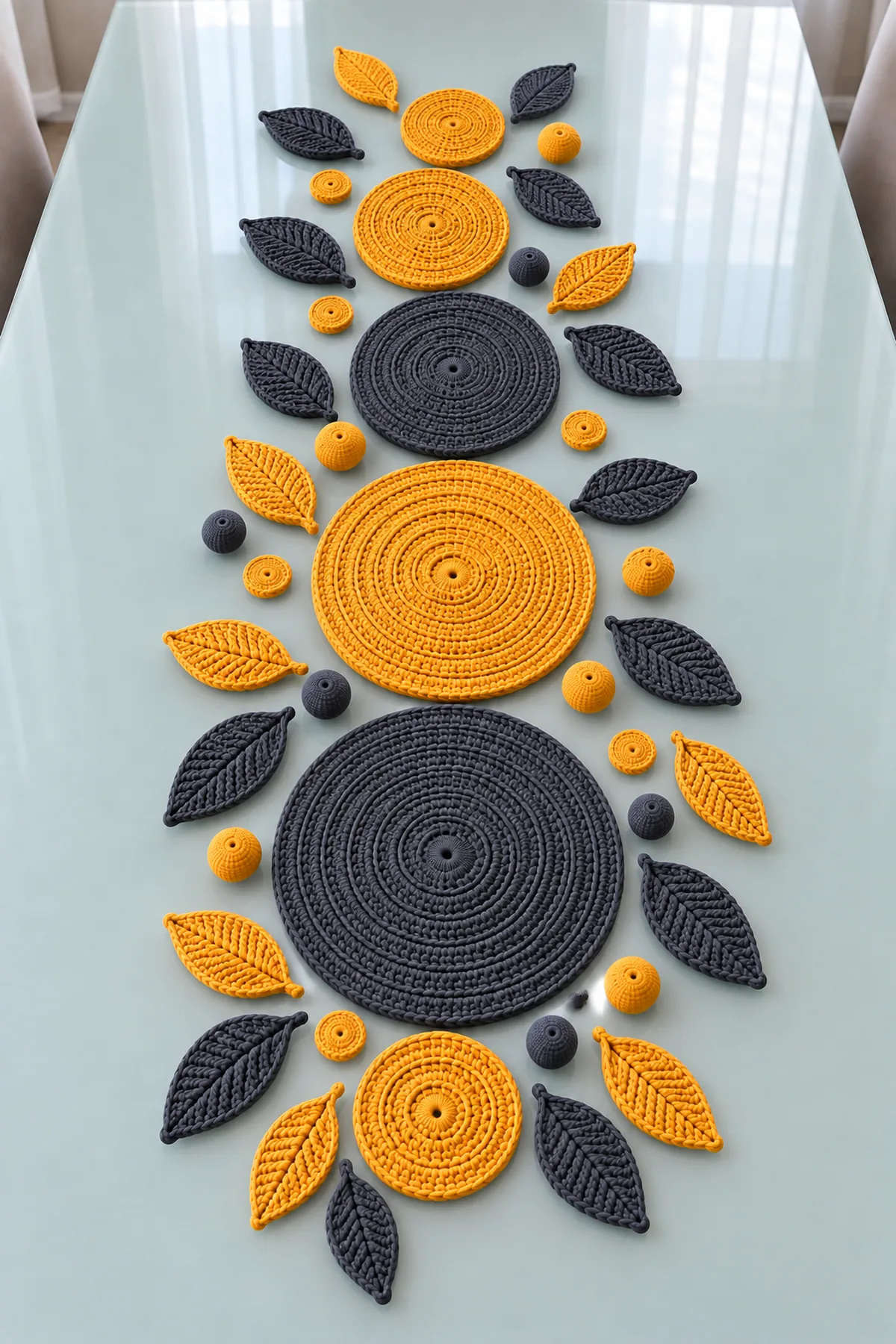
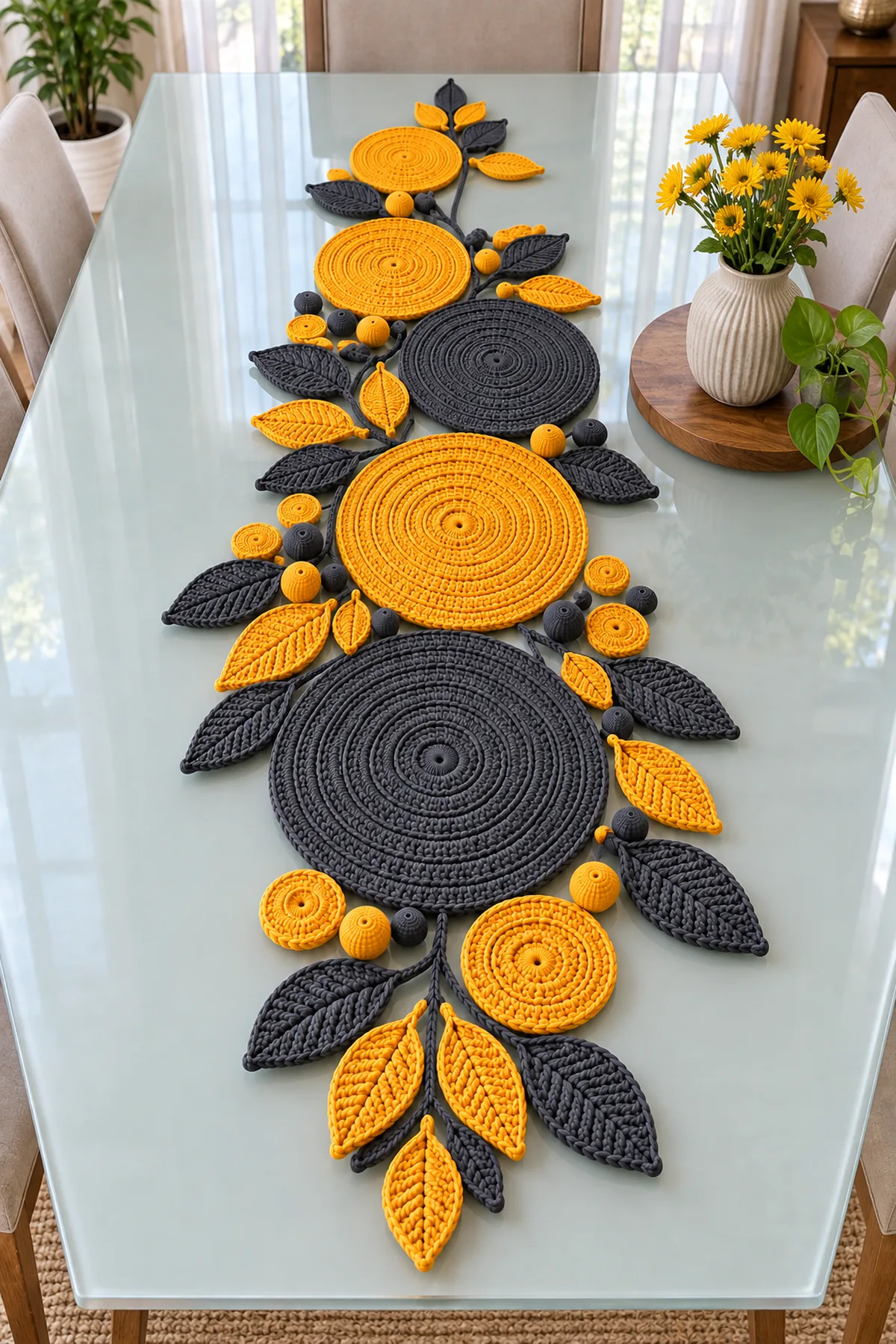
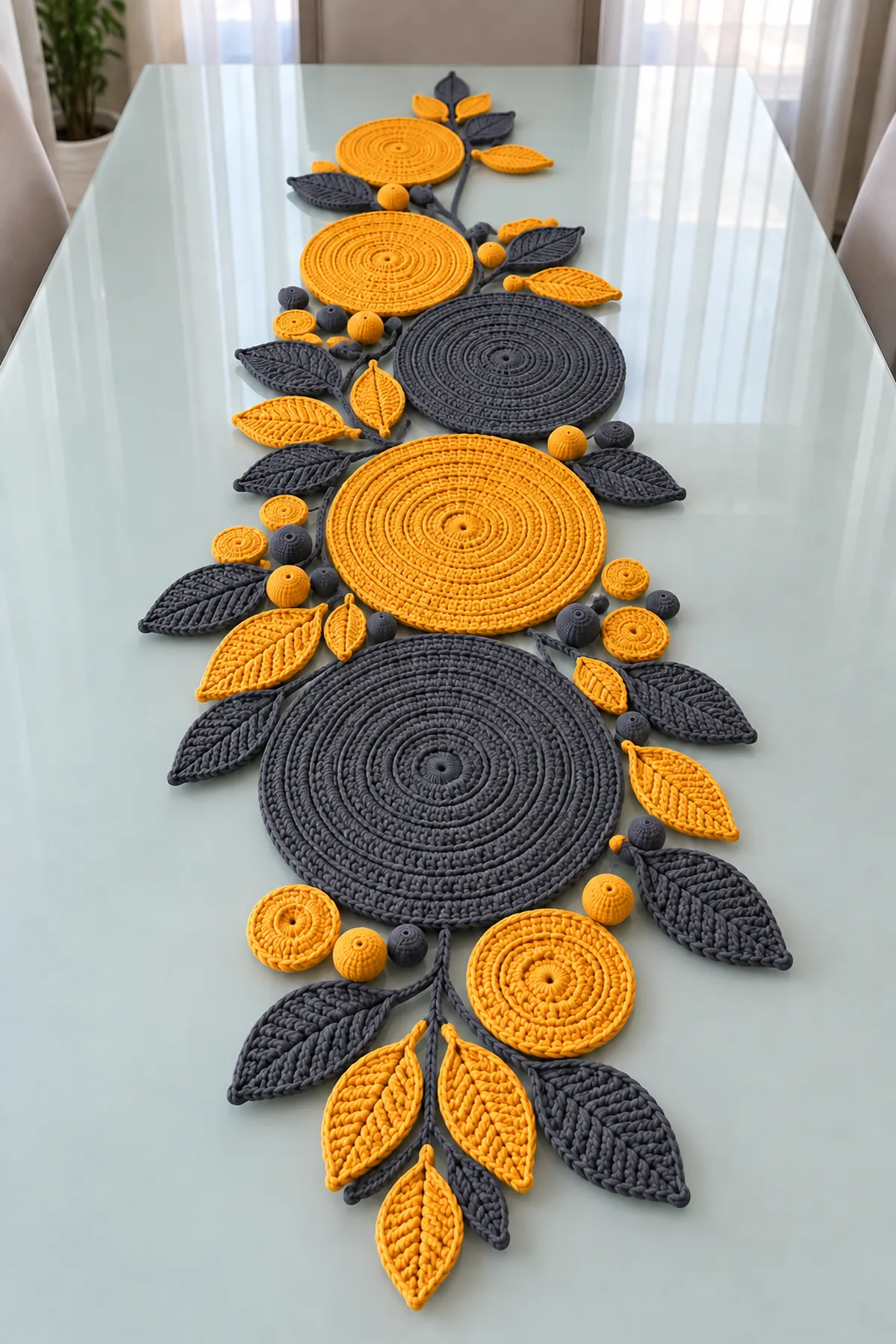
This Mustard Yellow & Gray Crochet Table Runner uses the same modern round-motif construction as the supplied photograph. Six solid crocheted disks form a long asymmetric path instead of a rectangle: four mustard circles and two charcoal circles change size as they travel from the narrow top through the broad center to the pointed lower end. Pointed ribbed leaves, small two-color coin motifs, and rounded bobble accents fill the edges while leaving plenty of table visible between the pieces.
Thank you for reading this post, don't forget to subscribe!Crochet six flat circles from counted increase rounds, making four in mustard and two in charcoal. Block them to the photographed graduated sizes and overlap their edges into one offset vertical path. Add eighteen ribbed leaves, six small coin motifs, and eight firm bobble accents. Sew every component through solid stitches so the runner remains flexible but stable, then block the complete botanical silhouette to a straight measured length.
Why You’ll Love This Project
The large circles are meditative to crochet, and the limited mustard-and-gray palette looks clean and contemporary. Because the runner has no solid background, a glass or wooden tabletop shows through around the leaves and small accents. The modular construction also makes the length easy to customize while preserving the modern asymmetrical rhythm.
Materials
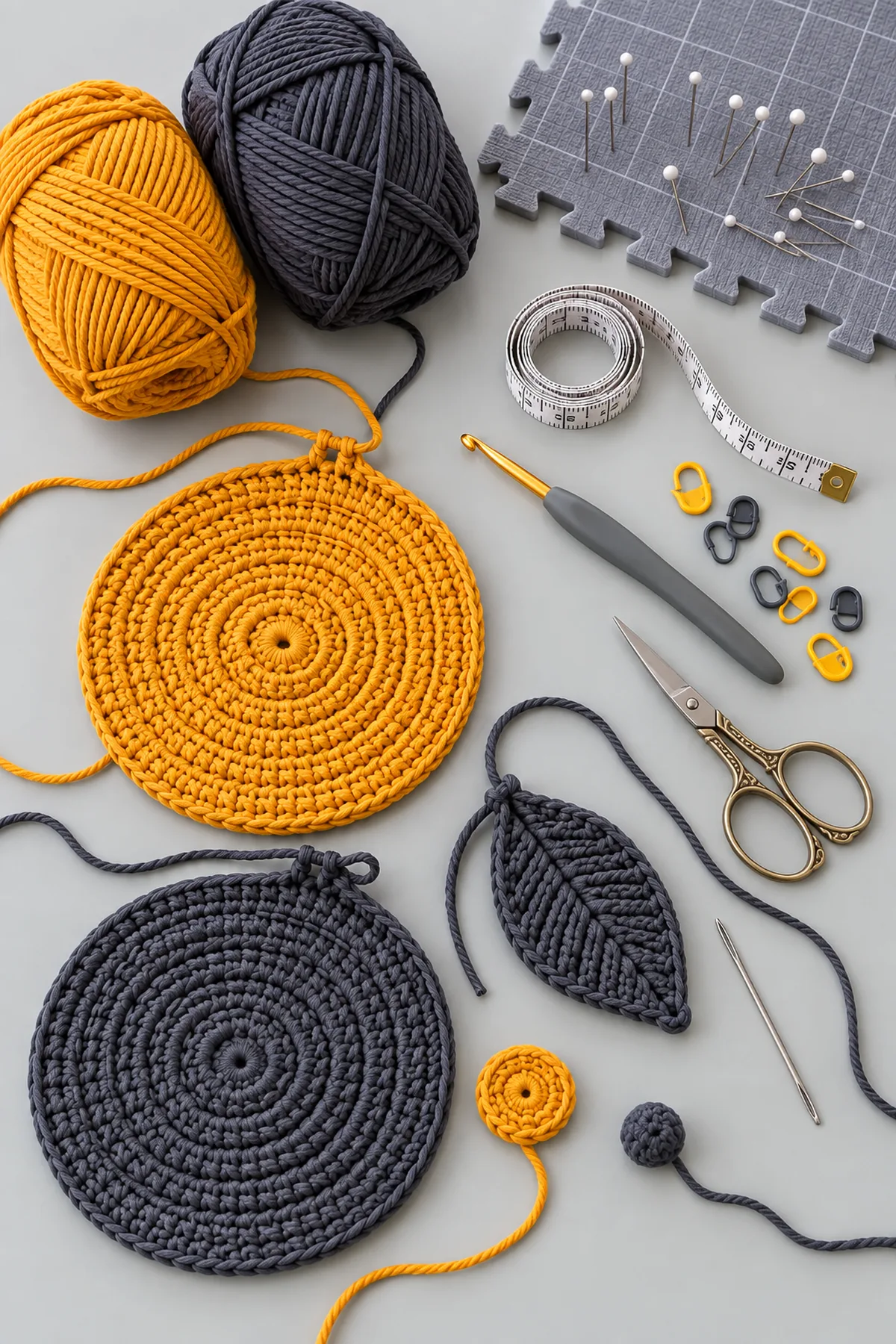
- About 650 yards mustard-yellow worsted cotton yarn
- About 590 yards charcoal-gray worsted cotton yarn
- 4.0 mm crochet hook
- Yarn needle and sharp scissors
- Twenty locking stitch markers
- Tape measure, blocking mats, and rustproof pins
Gauge, Measurements, and Planning
Rounds 1–3 of every disk establish 10, 20, and 30 stitches. Work and block the lower charcoal disk first: it should measure about 15 inches across after eleven rounds. The central mustard disk measures about 14 inches, the upper charcoal about 12 inches, the upper-left mustard about 10 inches, and the two mustard end disks about 8 to 9 inches. Adjust the hook before continuing if the first disk differs by more than half an inch.
Make and wash a gauge swatch before beginning. Measure only after the swatch is completely dry. If the stitch width differs, change hook size rather than pulling the working yarn tighter. Keep a written count at the end of every section so the finished edges remain balanced and the assembly points line up.
Abbreviations and Special Stitches
- ch: chain
- sc: single crochet
- hdc: half double crochet
- dc: double crochet
- sl st: slip stitch
- sp: space
- st(s): stitch(es)
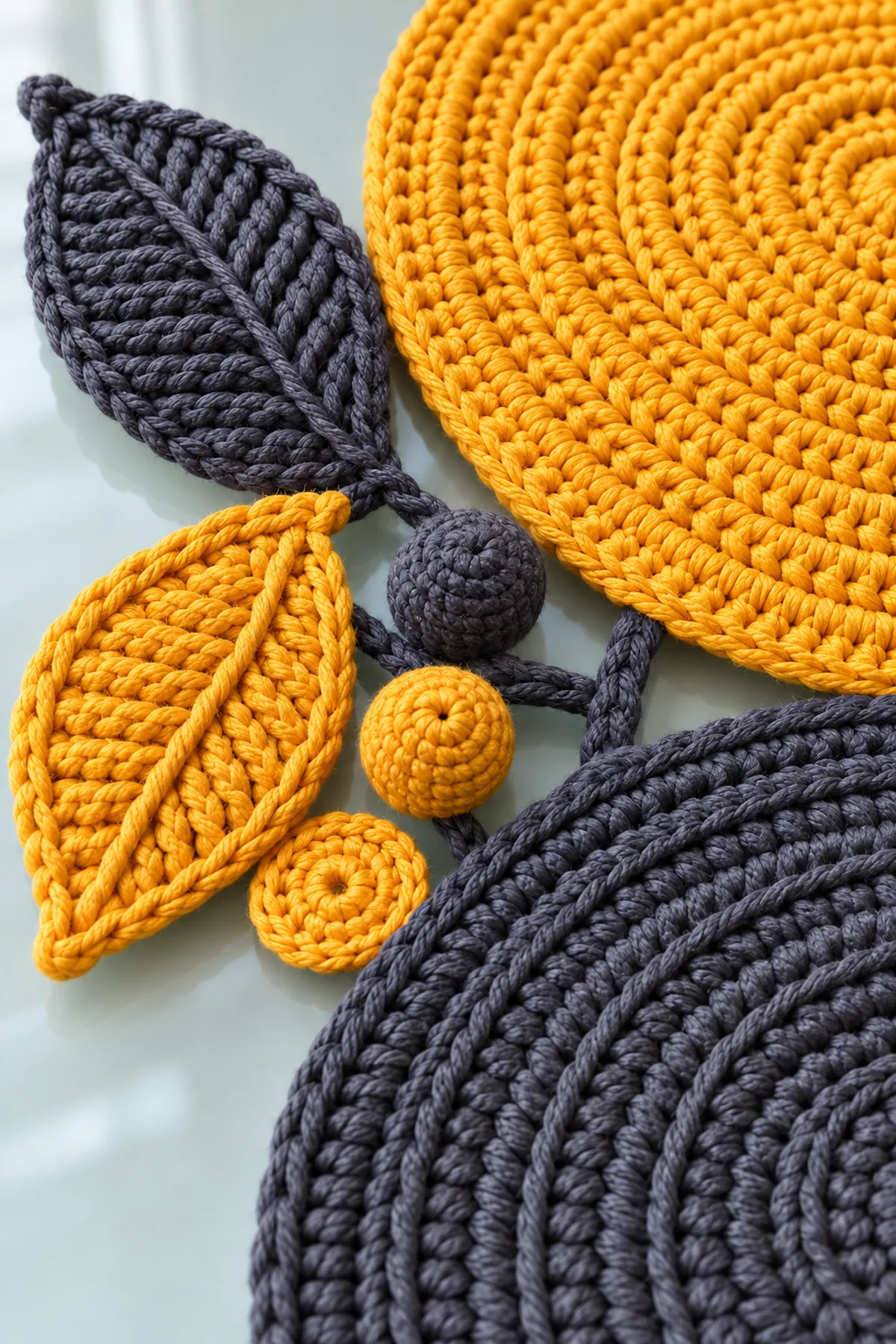
Special stitch guidance: Invisible increase: work two stitches into the same stitch and stagger increase points on every round. Ribbed leaf: work graduated stitches on both sides of a foundation chain, then surface-slip-stitch a raised center vein. Firm bobble: six unfinished dc closed together, followed by one locking chain. Surface join: slip stitch through the back loops of two overlapping motifs without piercing the tabletop-facing surface.
Before You Begin
- Make exactly six primary disks: four mustard and two charcoal.
- Keep all six circles flat by staggering increase points instead of stacking them into visible corners.
- Make exactly eighteen leaves, six small coin motifs, and eight bobble accents.
- The finished runner has open table space around every motif; do not add a solid or mesh background.
- Beginning chains do not count as stitches unless a step explicitly says they do.
Instructions
Crochet Six Graduated Modern Round Motifs
Use smooth, firm stitches and stagger every increase so each disk stays genuinely round while matching the photographed size changes.
- Round 1: Make a magic ring and work 10 hdc into it. Join to the first hdc and mark that stitch. (10 sts)
- Round 2: Work 2 hdc in each stitch around. Join. (20 sts)
- Round 3: Repeat [1 hdc in the next stitch, 2 hdc in the next stitch] ten times. Join. (30 sts)
- Continue the increase sequence by adding one more plain hdc between increases on every round. Stagger the first increase by one stitch on alternate rounds so the circle does not become decagonal.
- Make the lower charcoal disk through Round 11, the central mustard disk through Round 10, and the upper charcoal disk through Round 9. Finish each with one even round of sc.
- Make the upper-left mustard disk through Round 8. Make the top mustard disk through Round 7 and the bottom mustard disk through Round 7. Finish each with one even sc round and block all six circles flat.
Arrange and Join the Six-Motif Center Path
The circles overlap lightly in the same offset rhythm as the reference rather than stacking in one rigid column.
- Lay the six blocked disks from bottom to top in this order: small mustard, largest charcoal, large mustard, upper charcoal, medium mustard, small mustard. This gives four mustard motifs and two charcoal motifs.
- Shift the lower mustard slightly right, the largest charcoal left, the central mustard right, the upper charcoal farther right, and the two upper mustard disks back toward the left and center, matching the photographed asymmetry.
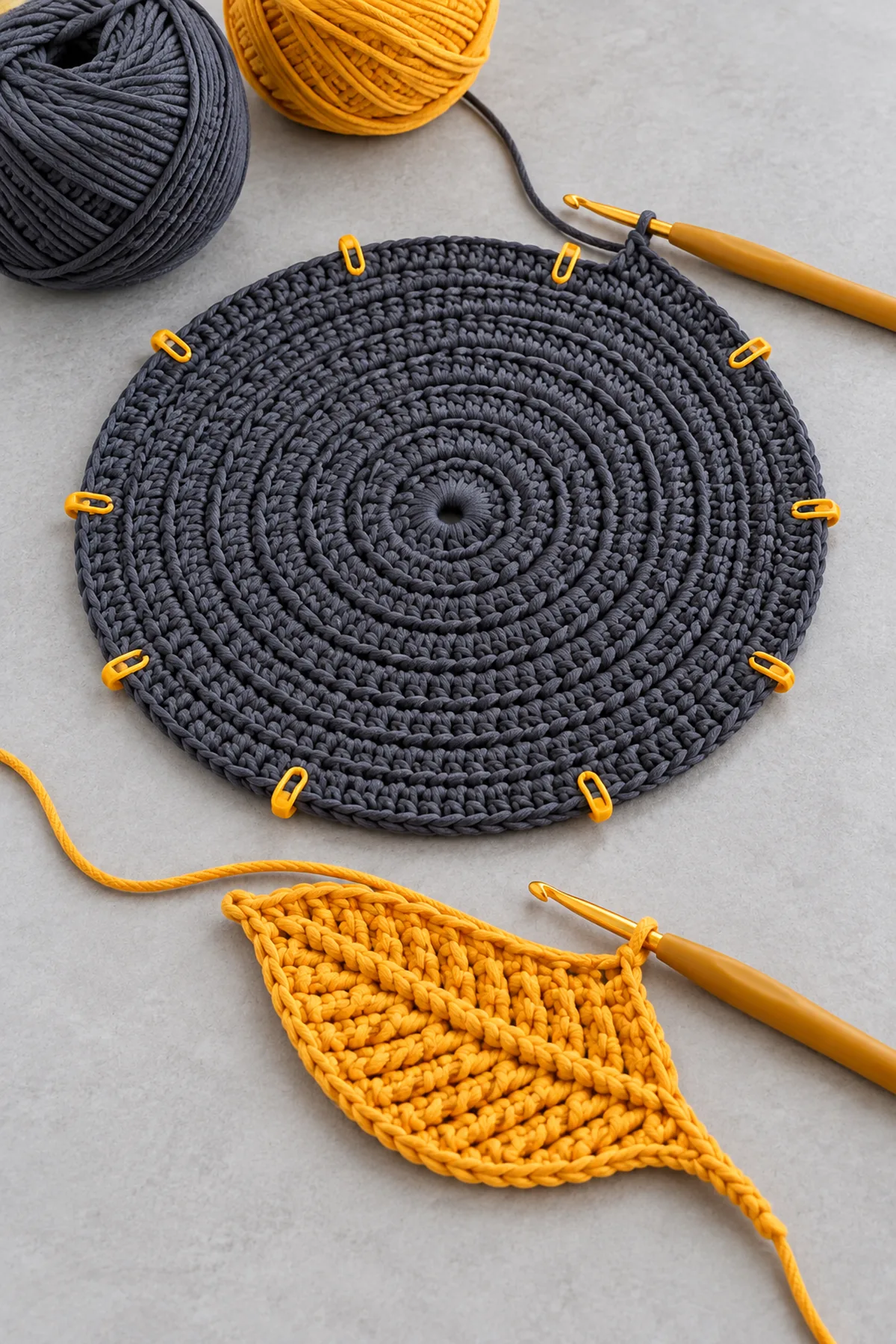
- Overlap neighboring edges by approximately 1 to 1.5 inches. Mark six matching stitches at each overlap without stretching either circle.
- With matching yarn, surface-slip-stitch through the back loops of the six marked stitches. Make exactly five disk-to-disk joins.
- Spread the joined path on the blocking grid. Confirm that all six centers remain individually visible and the total length is approximately 49 inches before leaves and end accents are added.
Make Ribbed Leaves, Small Coins, and Bobbles
The side motifs create the botanical silhouette while preserving open table space.
- Make eighteen pointed leaves: ten charcoal and eight mustard. For each leaf, ch 17. Down the first side work sl st, sc, hdc, 10 dc, hdc, sc, sl st; repeat in reverse along the other side and add a chain-2 point at the tip.
- Surface-slip-stitch from the leaf base to its tip to form the raised center vein. Block the leaves to approximately 5 inches long.
- Make six small coin motifs, three in each color. Work 8 sc in a magic ring, 16 hdc in Round 2, and 24 dc in Round 3; finish with reverse single crochet.
- Make eight firm bobbles, four mustard and four charcoal. Work six unfinished dc into a magic ring, close them together, ch 1, and wrap the remaining yarn around the base before fastening securely.
- Weave all motif tails except one long sewing tail on every leaf, coin, and bobble.
Build the Modern Botanical Edging
Cluster the small pieces asymmetrically around the round center path without filling every gap.
- Pin four or five leaves around each large charcoal disk, alternating mustard and charcoal. Angle the tips outward so they follow the long runner silhouette.
- Place the remaining leaves near both medium mustard end disks. Keep the very top and bottom tips narrow enough for a 17-inch finished width.
- Distribute the six small coins between disk joins: place two near the lower charcoal disk, two around the large mustard center, and two near the upper charcoal disk.
- Group the eight bobbles in pairs or trios beside the small coins, mixing mustard and charcoal. Do not place bobbles in a perfectly repeated sequence.
- Sew leaf bases and center veins to solid disk stitches. Attach coins along one-third of their circumference and secure every bobble through its gathered base. Wet-block the complete runner to approximately 17 by 56 inches.
Assembly and Shaping
Begin with the six-disk center path and verify the bottom-to-top mustard-charcoal-mustard-charcoal-mustard-mustard order before sewing. Attach leaves only after all five circle joins lie flat. Keep the side clusters visually full but leave clear table space between them. Small coins bridge awkward gaps; bobbles add height but should never carry structural tension.
Lay every component on a flat surface before joining. Match the marked centers first, then divide each remaining edge into equal sections. Work through both layers with consistent tension and pause after each section to check that the fabric lies flat. This measured approach prevents twisting and keeps decorative details facing the intended direction.
Finishing
- Weave disk tails along matching-color rounds so no dark ends show through mustard stitches.
- Reinforce each six-stitch disk overlap from the back.
- Pin all six circles truly round, straighten the center path, and shape every leaf point before drying.
- Remove the pins only when fully dry, then tug-test the five main joins, all leaf veins, coin edges, and bobble bases.
For a polished result, weave each tail through several same-color stitches, reverse direction once, and trim only after the fabric has been gently stretched. Block to the listed dimensions without flattening textured stitches. Inspect joins, borders, straps, and decorative pieces before the project is used or gifted.
Helpful Tips
- Count every increase round; missing one increase creates a shallow bowl instead of a flat disk.
- Rotate each new round’s first increase so the circles stay smooth and modern.
- Photograph the full pinned arrangement before sewing the small motifs.
- Use a firm cotton yarn so leaves hold their ribbed shape and bobbles remain rounded.
Good lighting and a contrasting stitch marker make counting much easier. If a section looks uneven, compare the current count with the previous checkpoint before continuing. Fixing one missed stitch early is faster than compensating later, and it preserves the measurements used by the assembly instructions.
Frequently Asked Questions
Can I make the runner shorter?
Yes. Use three primary disks in mustard-charcoal-mustard order, ten leaves, four small coins, and five bobbles.
Why are my round motifs ruffling?
Check that each round adds only ten stitches and that the final sc round contains no increases.
Can I use black instead of charcoal?
Yes, but charcoal shows stitch texture more clearly and creates a softer contrast with mustard yellow.
Conclusion
Six staggered round motifs—four mustard and two charcoal—plus eighteen ribbed leaves, six small coins, and eight raised bobbles create the modern botanical runner shown in the supplied photograph. Careful counted increases keep the circles flat, while five measured joins and open spacing preserve the long contemporary silhouette.
Printable Crochet Pattern Card
Project: Mustard Yellow & Gray Crochet Table Runner
Skill level: Intermediate Hook: 4.0 mm Yarn: Worsted
Finished size: Approximately 17 by 56 inches after blocking
Card Materials
- About 650 yards mustard-yellow worsted cotton yarn
- About 590 yards charcoal-gray worsted cotton yarn
- 4.0 mm crochet hook
- Yarn needle and sharp scissors
- Twenty locking stitch markers
- Tape measure, blocking mats, and rustproof pins
Card Instructions
- Crochet Six Graduated Modern Round Motifs: Make four mustard and two charcoal flat circles in six graduated sizes from counted 10-, 20-, and 30-stitch foundations.
- Arrange and Join the Six-Motif Center Path: Arrange six disks mustard-charcoal-mustard-charcoal-mustard-mustard from bottom to top and join five measured overlaps.
- Make Ribbed Leaves, Small Coins, and Bobbles: Crochet eighteen ribbed leaves, six small round coins, and eight raised bobble accents in the two-color palette.
- Build the Modern Botanical Edging: Arrange leaves, coins, and bobbles in asymmetric clusters around the five joined circles and block the runner flat.
Finish: Check every count, weave in all ends, block to measurement, and inspect each join.