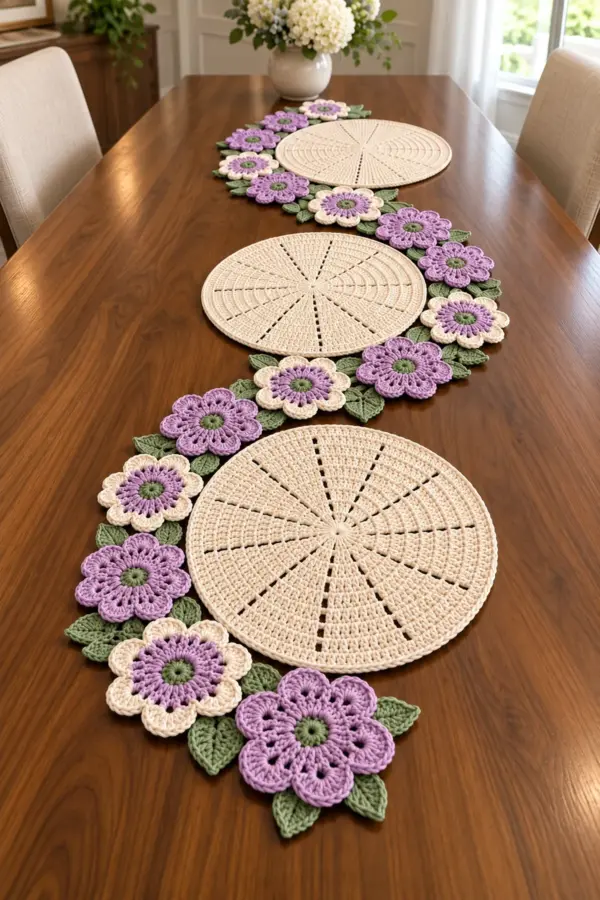
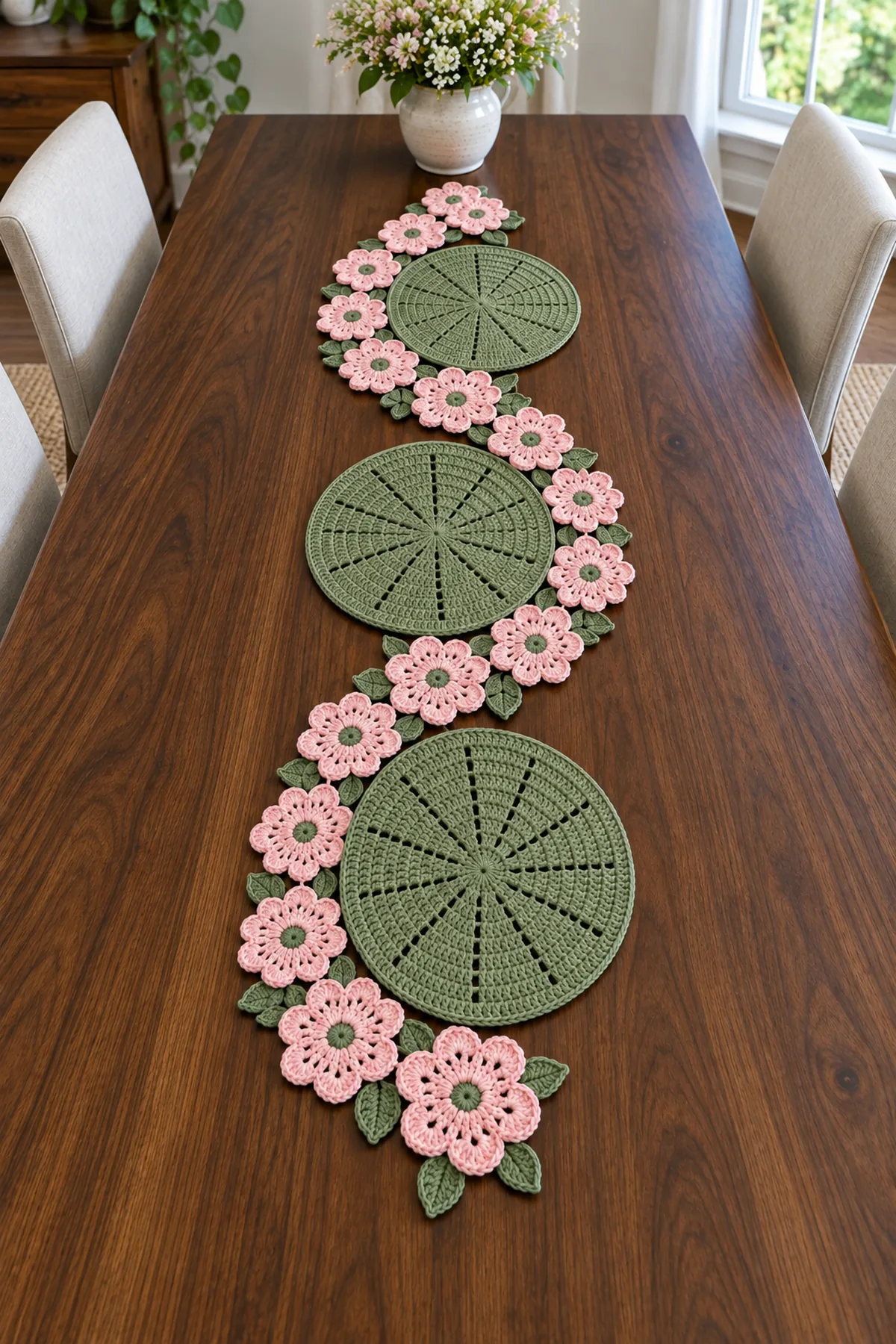
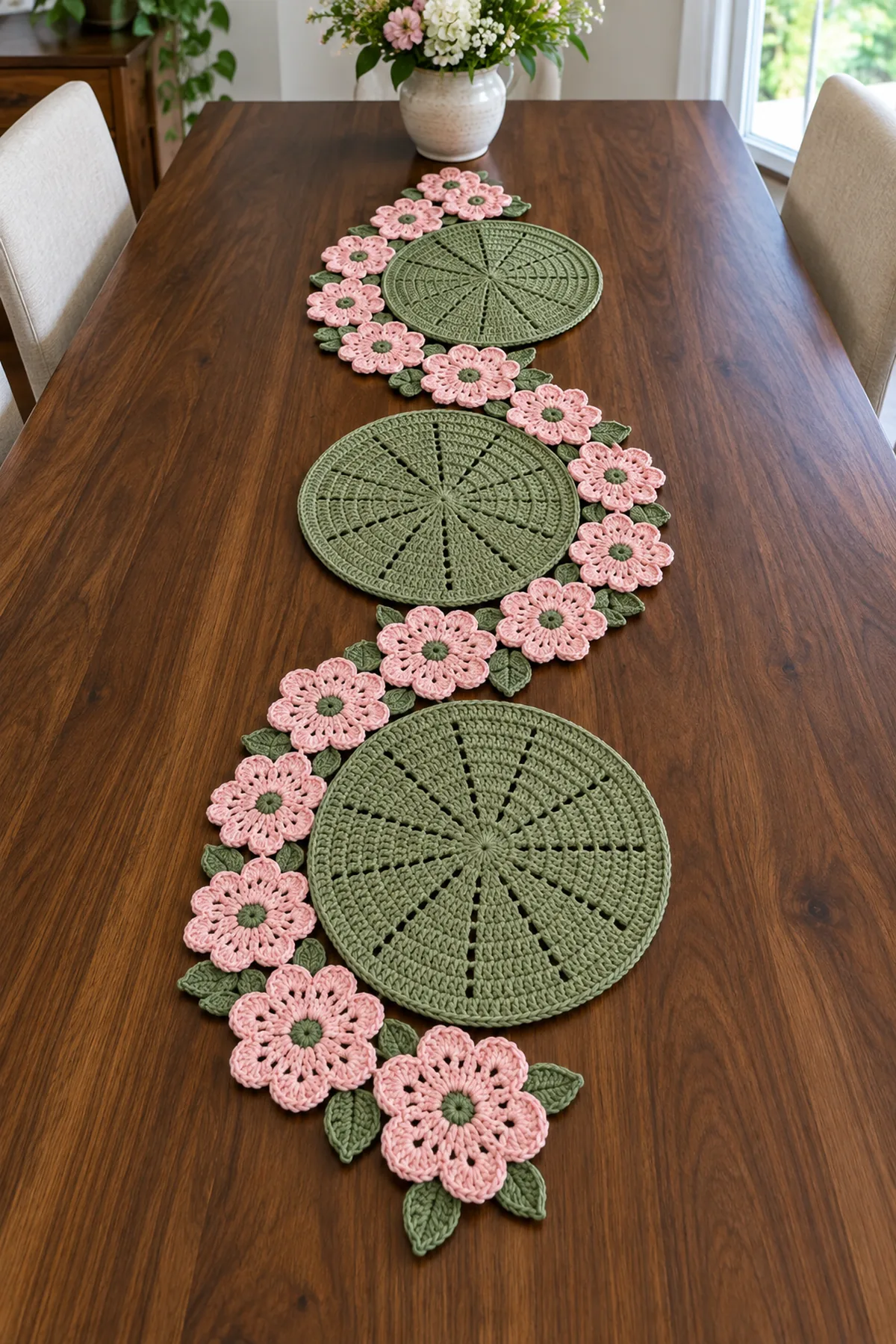
The Floral Garden Table Runner sets three textured sage crochet circles among a winding line of blush-pink blossoms. Small leaves fill the spaces between flowers, so the finished piece looks like a garland meandering across a wooden table rather than a conventional solid strip.
Thank you for reading this post, don't forget to subscribe!The circles and flowers are made separately and joined only after blocking. That makes this a satisfying portable project: finish one wheel or a few flowers at a time, then arrange the entire garden path before sewing. The open radial spokes add lightness to the broad green circles, while the layered petals bring a soft spring color.
Why You’ll Love This Floral Garden Runner
The modular layout can be checked on the actual table before attachment. Three equal circles keep the design grounded, and the flower chain can curve naturally around their edges. Each blush blossom has a darker sage center, echoing the three medallions without making the runner too busy.
Pattern Details
- Skill level: Intermediate
- Hook: 3.5 mm
- Yarn: DK-weight mercerized cotton
- Finished size: Approximately 14 inches wide by 52 inches long
- Gauge: 20 dc and 10 rounds equal 4 inches in a solid sample
- Terminology: US crochet terms
- Estimated time: 18–22 hours
Materials
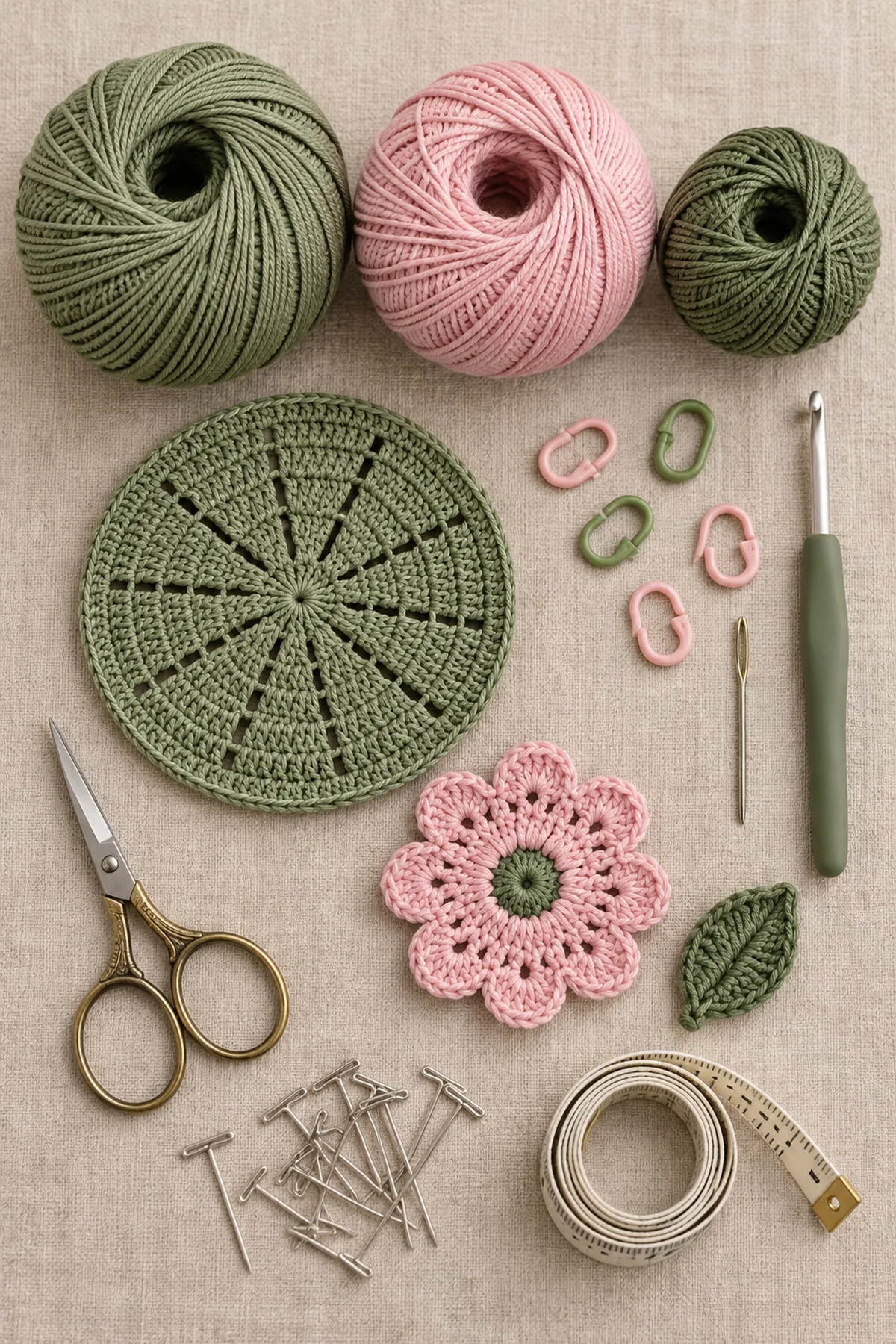
- 650 yards muted-sage DK-weight cotton
- 310 yards blush-pink DK-weight cotton
- 35 yards darker-sage DK-weight cotton for flower centers
- 3.5 mm crochet hook
- Twenty-four locking markers
- Yarn needle, scissors, tape measure, blocking mats, and rustproof pins
Gauge, Measurements, and Layout
Each blocked sage circle measures approximately 13.5 inches across. Place the three circles along a straight center line with a 4-inch space between neighboring edges. The circle chain spans about 48.5 inches; the outer flowers extend the overall length to approximately 52 inches. Keep the flowers within roughly 14 inches of total width.
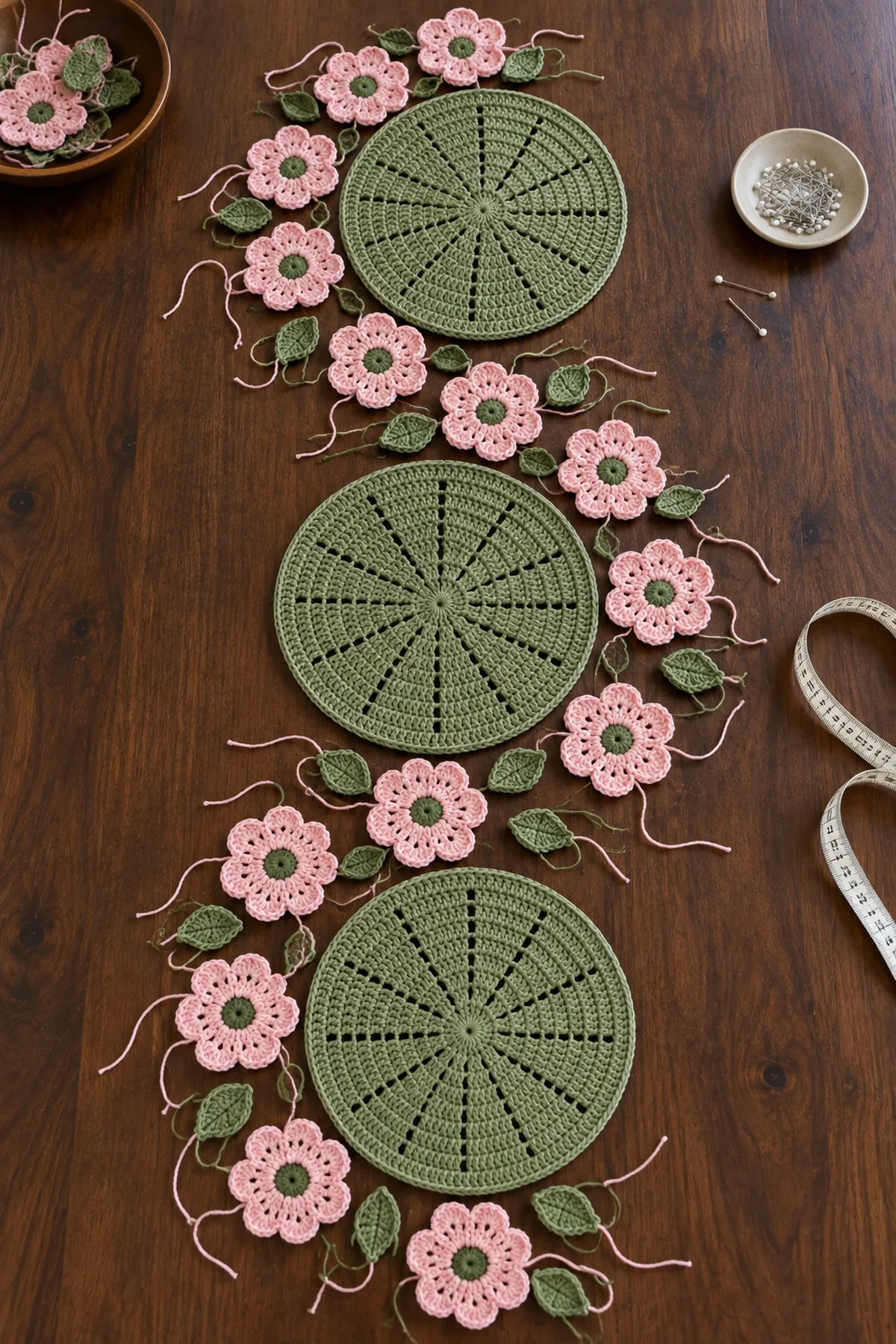
Make exactly three matching wheels, eighteen pink eight-petal flowers, and eighteen sage leaves. Plan six flowers and six leaves around each wheel. The winding flower route alternates to the left of the first circle, to the right of the middle circle, and back to the left of the final circle.
Abbreviations and Special Stitches
- ch: chain
- dc: double crochet
- hdc: half double crochet
- sc: single crochet
- sl st: slip stitch
- st(s): stitch(es)
- sp: space
Wheel increase: Work two dc in one marked stitch.
Open spoke: Ch 1 over one stitch position, then work in that chain space on the next round.
Pink petal: Work sc, hdc, 3 dc, hdc, sc in one petal space.
Small popcorn: Work 4 dc in one space, remove the hook, insert it in the first dc, pull the active loop through, and ch 1 to close.
Ribbed leaf: Work around both sides of a foundation chain and surface-slip-stitch the center vein.
Before You Begin
- Beginning chains do not count as stitches unless stated.
- Use a contrasting marker for the first stitch of each circle round.
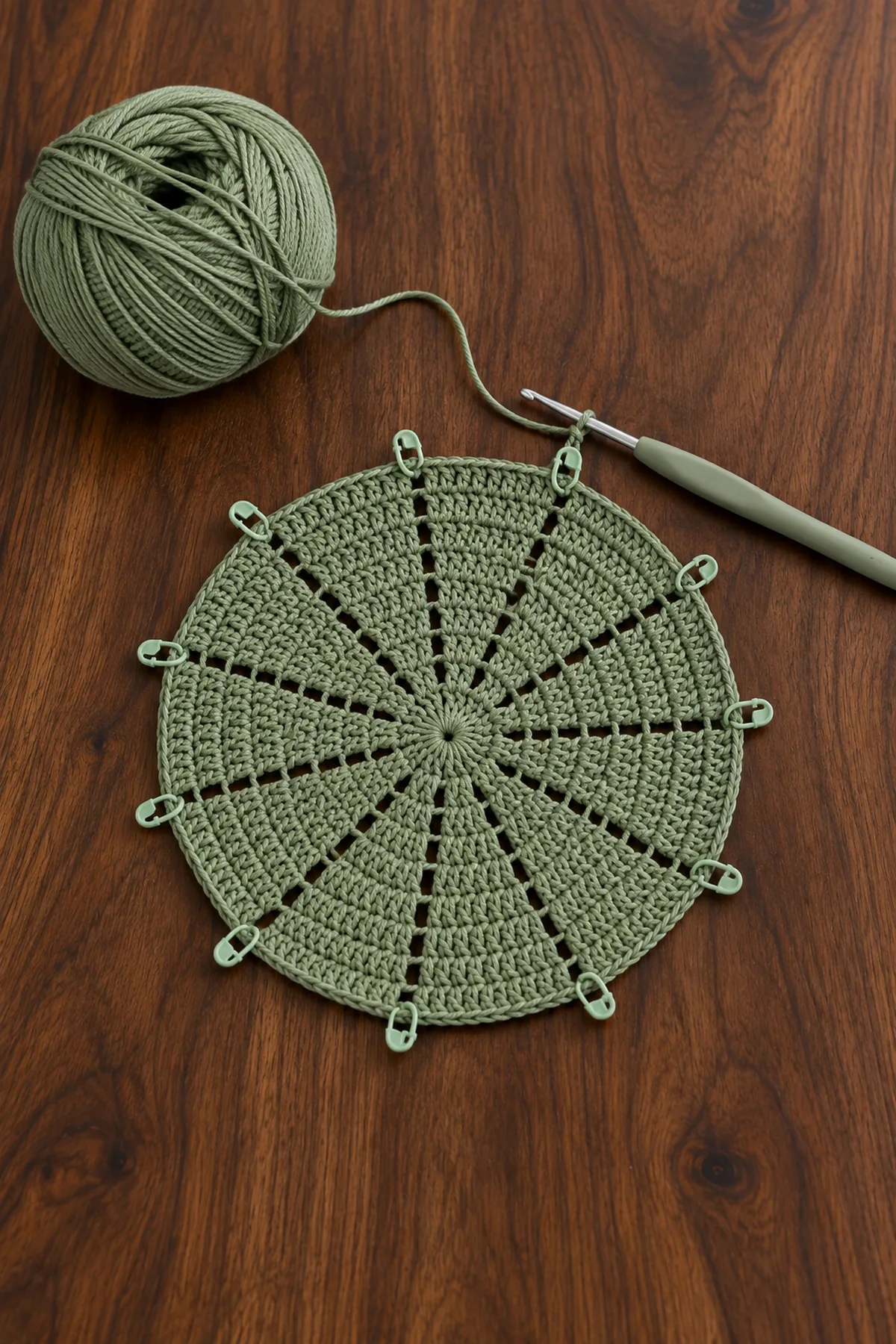
- Divide each circle into twelve marked wedge sectors to spread increases evenly.
- Photograph the entire table layout before joining any flower.
Floral Garden Table Runner Instructions
Make Three Sage Wheel Medallions
- Round 1: Make a magic ring and work 12 dc into it. Join to the first dc, pulling the center closed. (12 sts)
- Round 2: Ch 2, work 2 dc in every stitch, and join. (24 sts)
- Round 3: Ch 2, repeat [dc in next stitch, 2 dc in next stitch] twelve times, and join. (36 sts)
- Rounds 4–18: Continue twelve evenly spaced increases on each round, placing one increase in every marked wedge. Keep one chain-1 open spoke along each wedge boundary by replacing one dc position with a chain and working into that chain space on the next round. The chain counts as one position. End Round 18 with 216 positions.
- Round 19: Work one dc in every solid stitch and one dc in every open-spoke chain space. Join, fasten off, and weave the tail into the outer round.
- Block the circle to approximately 13.5 inches. Make two more identical circles, opening all twelve radial spoke lines.
Make Eighteen Blush Flowers
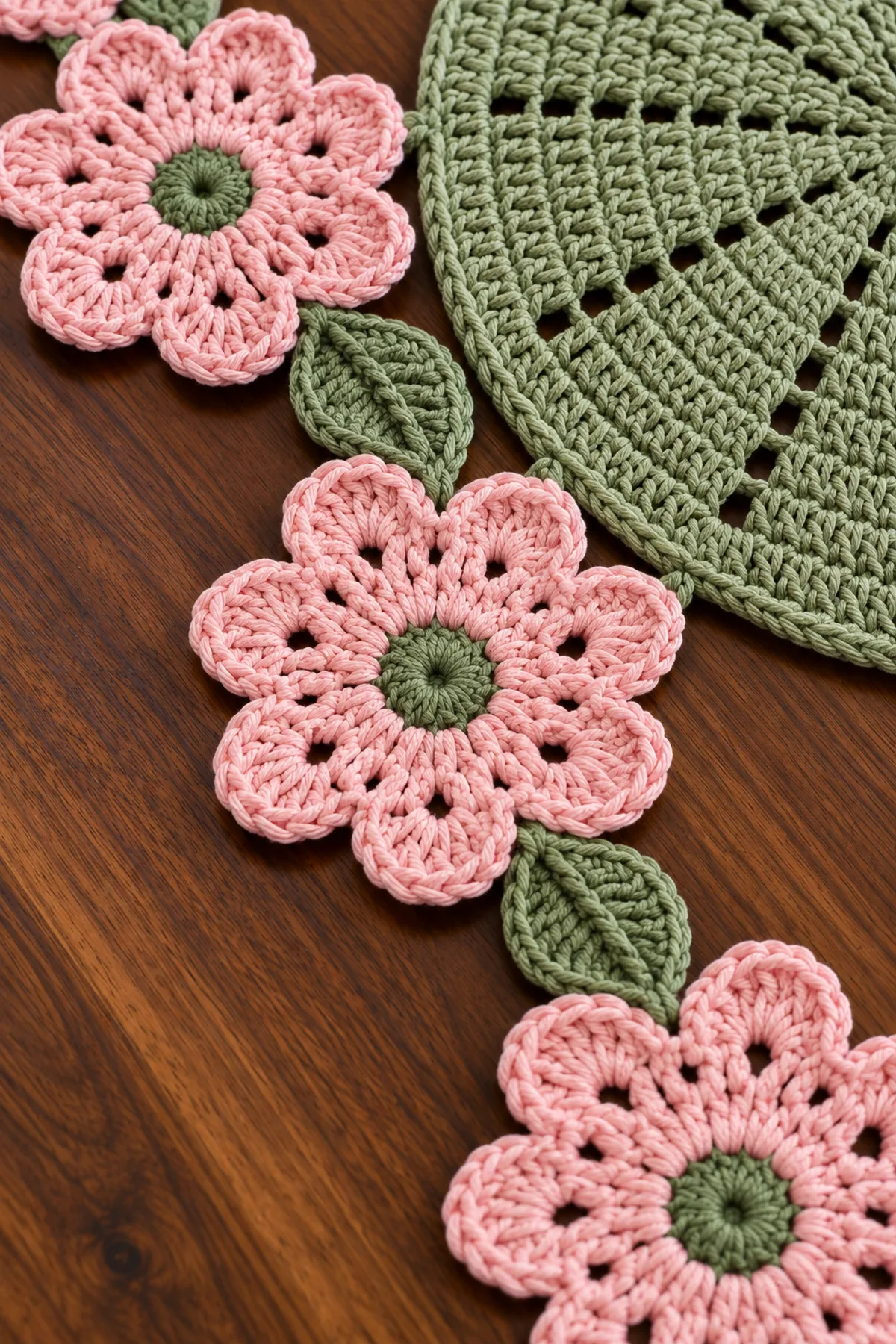
- With darker sage, make a magic ring and work eight small popcorn stitches into it. Join and fasten off.
- Join blush behind the center. Make eight chain-5 spaces, one behind each popcorn.
- Work one pink petal in every chain-5 space. Slip stitch to the first petal base and fasten off with a long sewing tail.
- Block each flower to about 3 inches across. Make exactly eighteen flowers with the same petal count and sage center.
Make Eighteen Small Sage Leaves
- Ch 12 in muted sage. Work a slip stitch in the second chain, then sc, hdc, 5 dc, hdc, sc, and sl st along the foundation.
- Turn the work around the far end of the chain and mirror the stitches along the underside.
- Surface-slip-stitch the center chain to make a raised vein. Fasten off with a long tail.
- Repeat until eighteen leaves are complete; block their tips before arranging them.
Lay Out the Winding Garden Path
- Place the three circles along the table’s center line with 4 inches between neighboring edges.
- Arrange six flowers around each circle. Put more flowers on the left of the first wheel, on the right of the middle wheel, and again on the left of the final wheel.
- Place one sage leaf between neighboring flowers. Angle leaves outward so their tips remain visible beside the petals.
- Use a length of sage yarn to map an S-shaped connecting line behind the flowers. Photograph the layout and mark every point where a flower meets a wheel.
Join the Wheels, Flowers, and Leaves
- Beginning at the first end, chain a narrow sage stem along the marked S-shaped route, using slip stitches into the backs of flowers to connect them in sequence.
- At each point where a flower overlaps a wheel, whipstitch through the flower center base and two solid outer-round stitches of the wheel.
- Bridge the 4-inch gap between neighboring wheels with three adjacent flowers. Join their petals edge to edge and sew the sage stem behind them for support.
- Sew one leaf behind each flower, then anchor each leaf base to the stem or a wheel edge.
- Turn the runner over and add a second securing stitch at both wheel-to-flower bridges. The entire assembled piece should lift as one connected runner.
Assembly and Shaping
Keep the sage circles evenly spaced while the flower path changes sides. The winding line should feel continuous from one terminal blossom to the other, but every wheel must remain clearly visible. Re-pin the flowers if a gap looks too wide or one side carries more visual weight.
Finishing
- Weave all wheel tails into the dense outer rounds, never across the open spokes.
- Hide pink flower tails beneath petal bases and sage tails along the back of the stem.
- Mist-block the finished piece, pinning the three circles flat and opening each pink petal.
- Check both flower bridges and all leaf bases from the back before moving the runner to the table.
Helpful Tips
- Count the twelve wheel wedges at the end of every round; moving an increase to a new wedge can distort a circle.
- Block all three wheels to the same diameter before planning the joins.
- Keep the flower tails long enough to sew through two layers at each contact point.
- Try the entire layout on the dining table before stitching the S-shaped route.
- Hand-wash gently in cool water, support both flower bridges when lifting, and dry flat.
Frequently Asked Questions
Can I make the runner shorter?
Yes. Use two circles, twelve flowers, and twelve leaves. Keep a single 4-inch gap and one secure flower bridge between the wheels.
Could I change the flower color?
Yes. Cream, dusty lavender, or pale peach can replace blush while the sage wheel and leaf construction stays the same.
Why does my sage circle ripple?
Check that each round adds exactly twelve increases and that no wedge receives two increases while another has none. Block the first circle before making the other two.
Conclusion
The finished Floral Garden Table Runner turns three simple sage wheels into a playful botanical centerpiece. Pink flowers trace a gentle curve around the circles, while small leaves and open radial spokes keep the modular design light and balanced.
Printable Crochet Pattern Card
Project: Floral Garden Table Runner
Skill level: Intermediate Hook: 3.5 mm Yarn: DK cotton
Finished size: Approximately 14 inches wide by 52 inches long
Card Materials
- Muted-sage, blush-pink, and darker-sage DK cotton
- 3.5 mm hook, markers, needle, scissors, tape measure, and blocking tools
Card Instructions
- Wheels: Make three flat sage circles with twelve marked radial wedges and open spokes.
- Flowers: Crochet eighteen eight-petal blush flowers with sage centers.
- Leaves: Crochet eighteen small ribbed sage leaves.
- Layout: Arrange circles 4 inches apart and weave the flowers around them in an S-shaped path.
- Join: Sew each flower bridge securely to both adjacent wheels and connect the path with a sage stem.
- Finish: Weave tails, inspect the joins, and block the full runner flat.