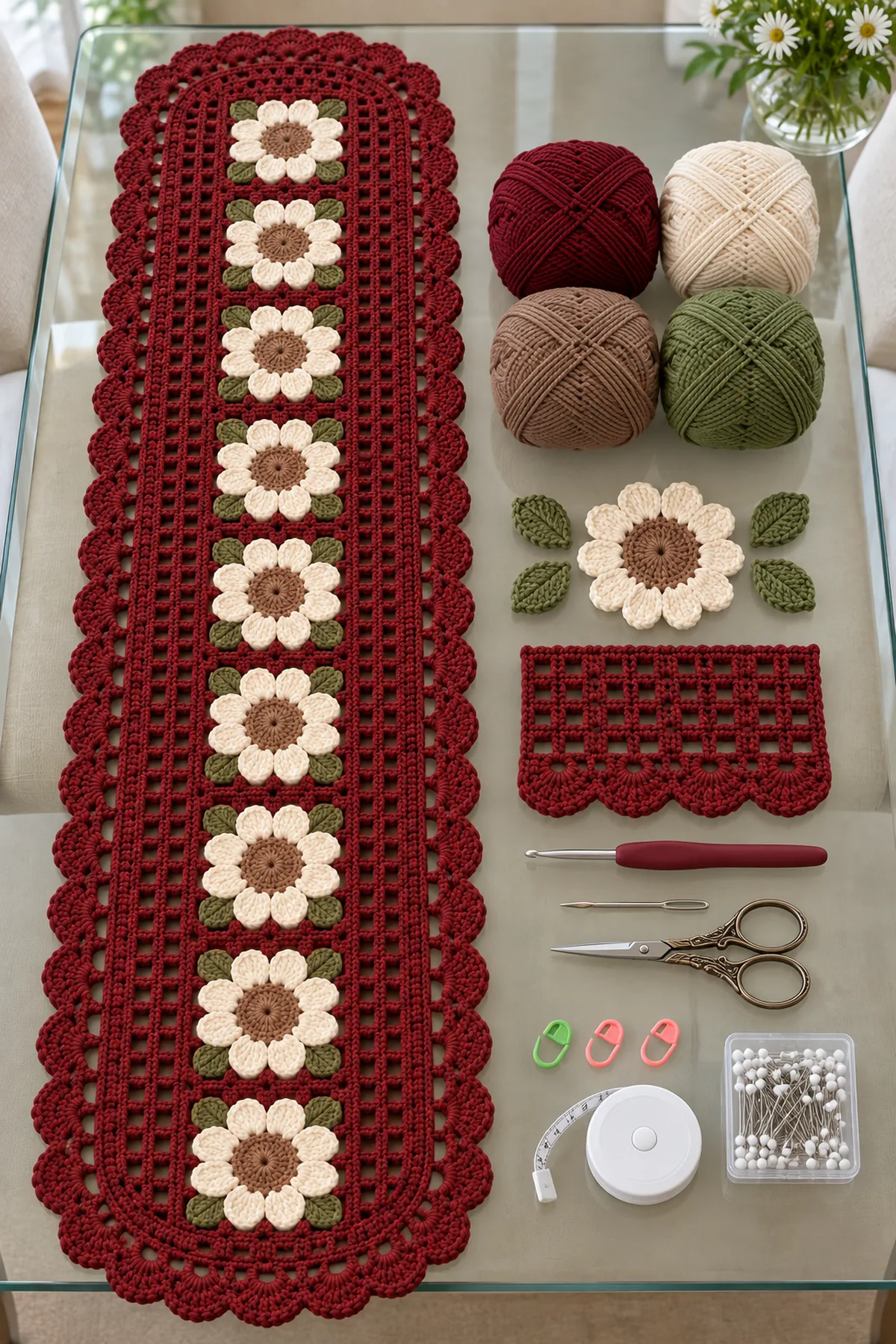
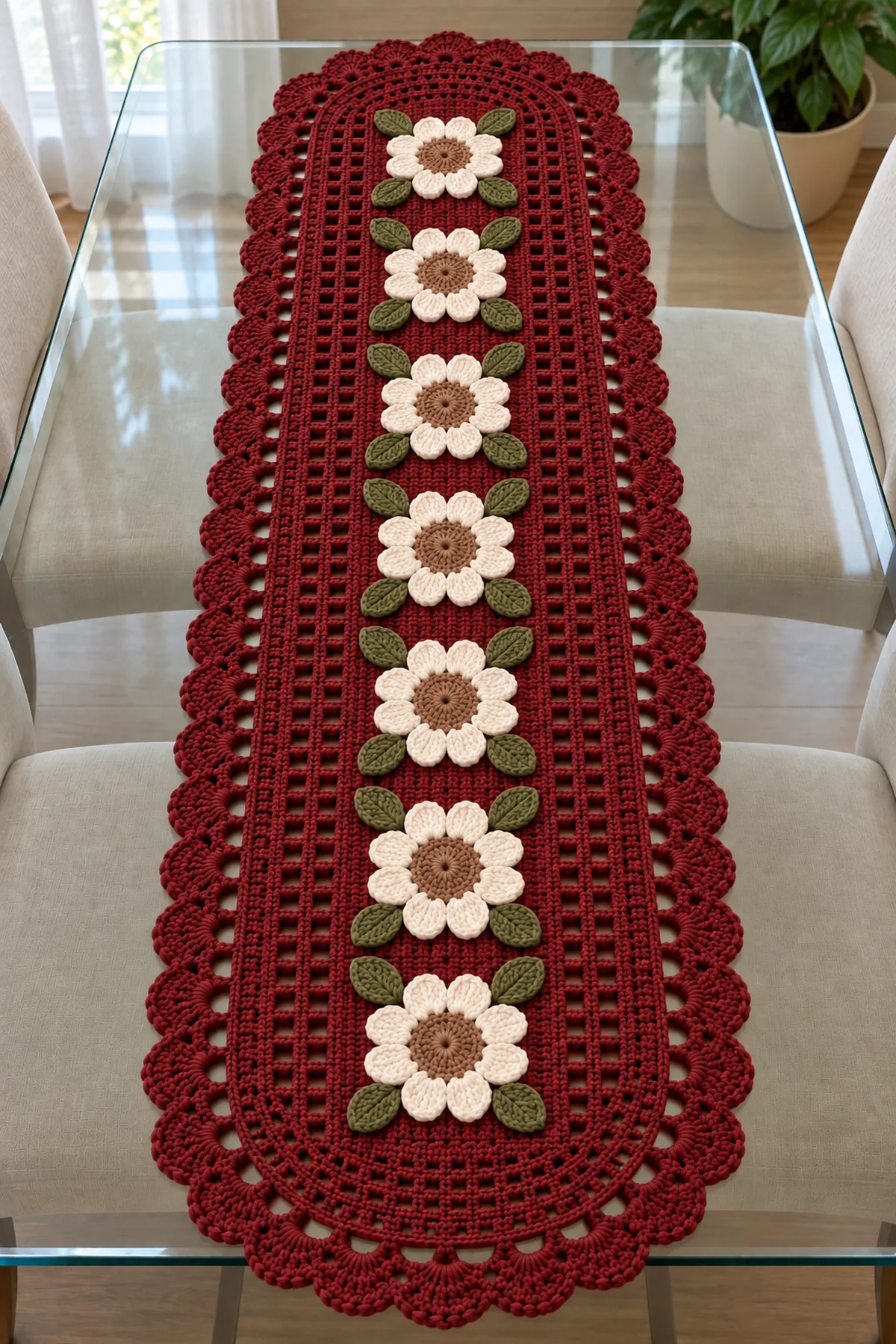
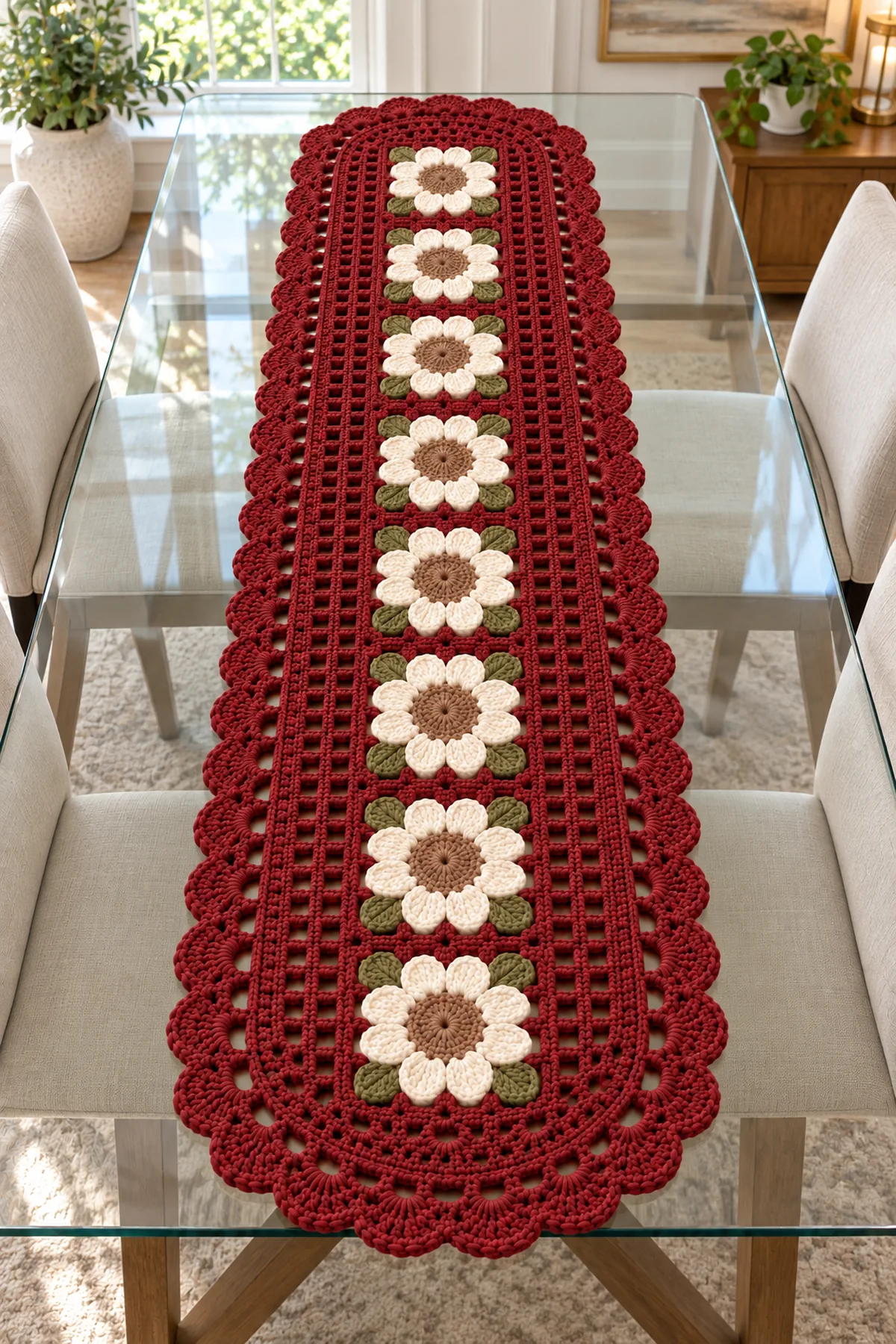
This Burgundy Daisy Floral Crochet Table Runner follows the supplied design as one long, richly textured burgundy runner. Seven large daisies sit in a single uninterrupted line through the center. Each flower uses one warm-taupe round center, twelve plump cream petals, and four muted-olive leaves. Narrow burgundy lattice channels run parallel to the floral strip, while the outside edge widens into deep open scallops and gently rounded ends.
Thank you for reading this post, don't forget to subscribe!Crochet the burgundy foundation as a long narrow panel, maintaining a solid central attachment strip and mirrored filet channels on both sides. Shape the upper and lower ends into shallow semicircles and work a broad scalloped border around the entire runner. Make seven identical twelve-petal cream daisies with taupe centers and twenty-eight small olive leaves. Block all pieces, mark seven evenly spaced center points, and sew the flowers in one straight vertical sequence with four leaves behind each bloom.
Why You’ll Love This Project
The monochrome burgundy lace creates a dramatic frame while the cream flowers remain easy to see. Repeating one flower and one leaf motif makes the embellishments portable, and the measured centerline keeps the formal design balanced from one rounded end to the other.
Materials
- About 1,250 yards deep-burgundy DK cotton for the panel and border
- About 390 yards warm-cream DK cotton for daisy petals
- About 150 yards warm-taupe DK cotton for seven flower centers
- About 260 yards muted-olive DK cotton for twenty-eight leaves
- 3.5 mm crochet hook
- Yarn needle, scissors, locking markers, tape measure, blocking mats, and rustproof pins
Gauge, Measurements, and Planning
The 61-position foundation should block to about 15 inches across before the outer scallops. Work the first 16 rows and verify that both side lattice channels mirror one another. The seven flower centers are marked approximately 7 inches apart along the exact centerline, leaving equal space above the first and below the final daisy.
Make and wash a gauge swatch before beginning. Measure only after the swatch is completely dry. If the stitch width differs, change hook size rather than pulling the working yarn tighter. Keep a written count at the end of every section so the finished edges remain balanced and the assembly points line up.
Abbreviations and Special Stitches
- ch: chain
- sc: single crochet
- hdc: half double crochet
- dc: double crochet
- tr: treble crochet
- sl st: slip stitch
- sp: space
- st(s): stitch(es)
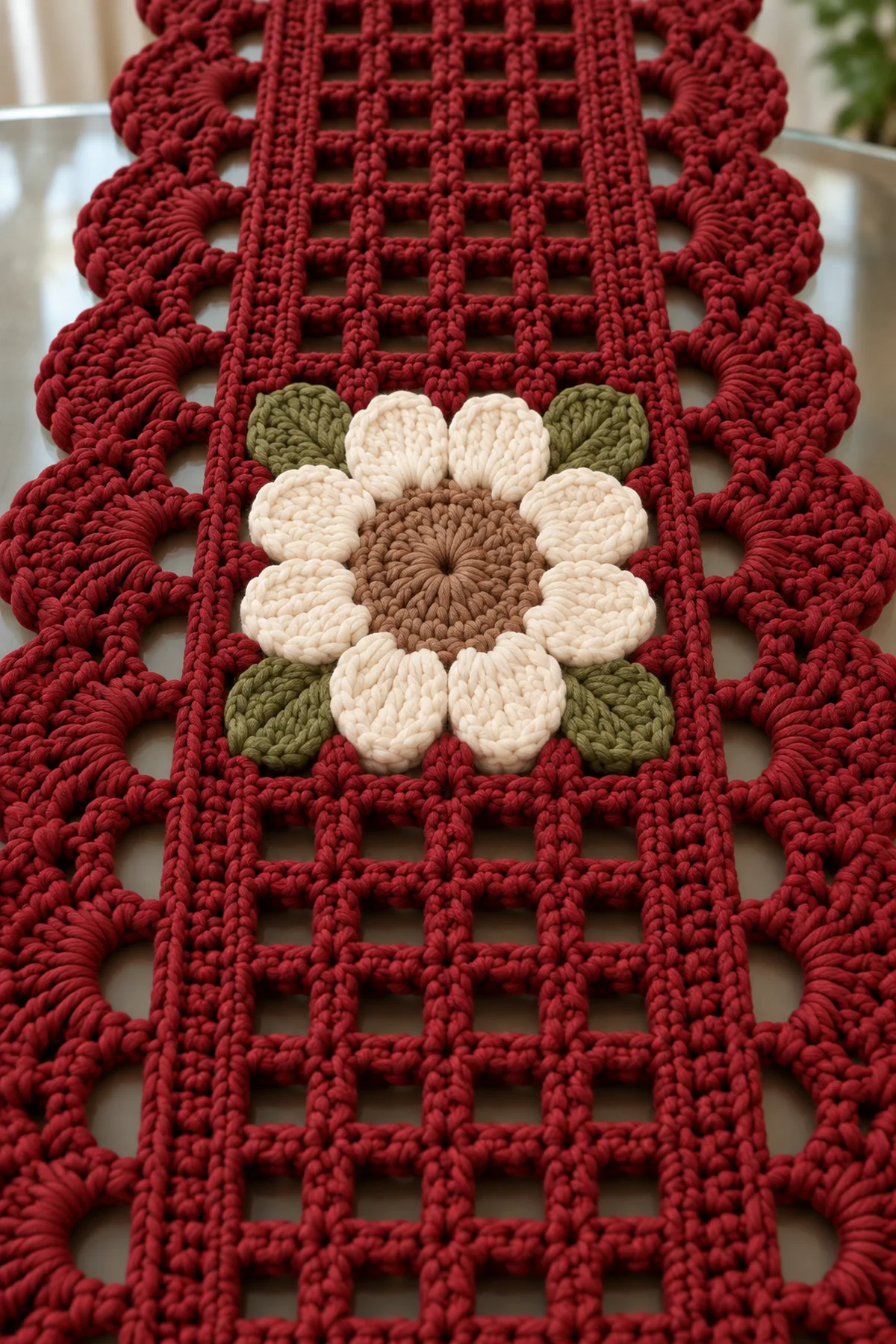
Special stitch guidance: Filet lane: repeat double crochet and chain-2 openings while preserving the marked solid posts. Raised daisy petal: work hdc, three dc, hdc into a chain arch, then surface-slip-stitch a center ridge. Ribbed leaf: mirror graduated stitches along both sides of a foundation chain and add a raised center vein. Deep scallop: work two dc, five tr, and two dc into one marked border space, then anchor with sc in the next space.
Before You Begin
- Make exactly seven daisies and place them in one straight center line.
- Every daisy has exactly twelve cream petals around one taupe center.
- Make exactly twenty-eight olive leaves, four for each flower.
- Keep the base, lattice channels, rounded ends, and wide outer scallops entirely deep burgundy.
- Do not replace the single flower line with squares, multiple columns, vines, or scattered blossoms.
- Beginning chains count only when a step explicitly says they do.
Instructions
Crochet the Long Burgundy Lace Panel
Maintain a solid floral corridor in the center and equal openwork channels along both sides.
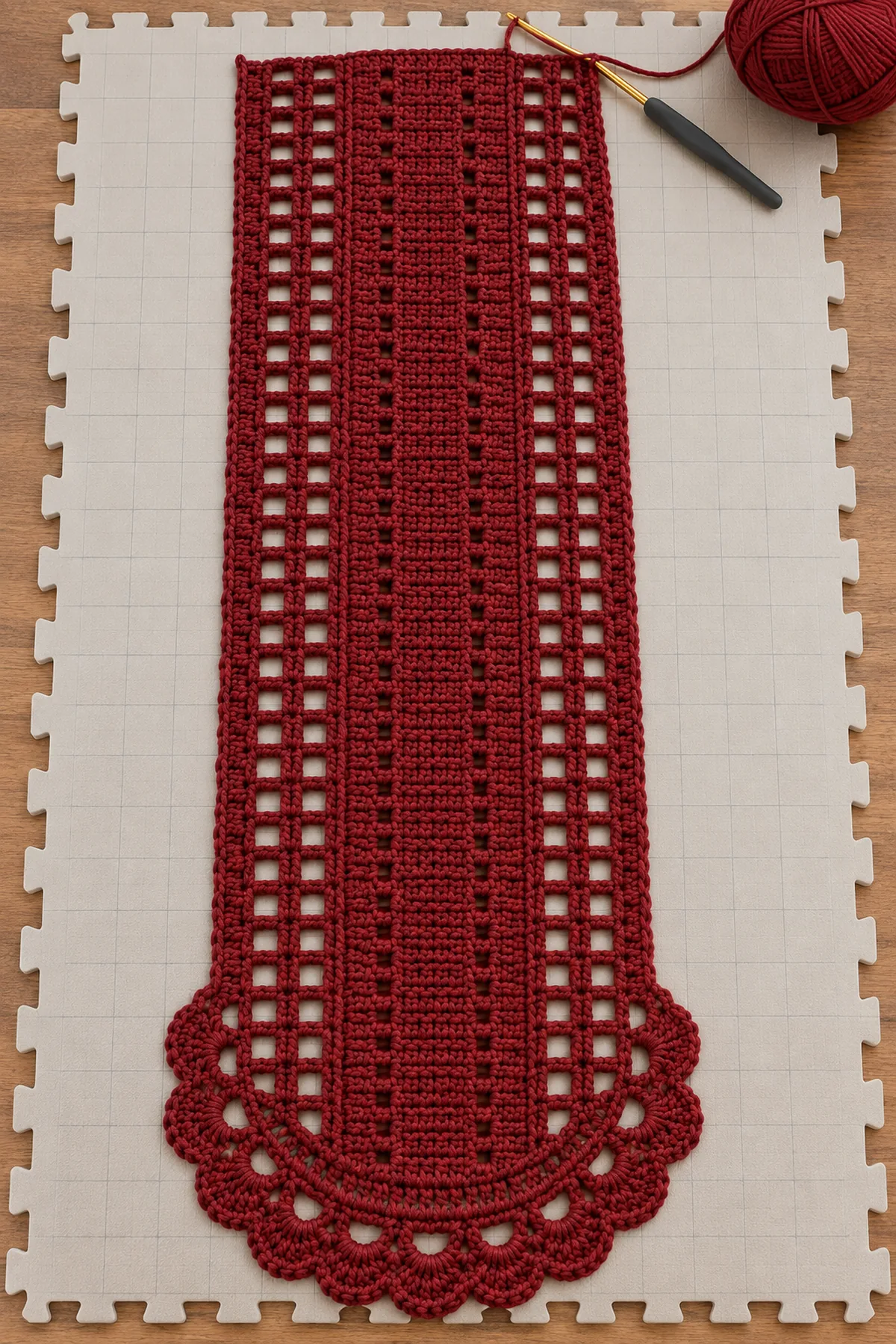
- With deep burgundy, ch 64. Beginning in the fourth chain, work across to establish 61 counted positions. (61 sts)
- Work Rows 2–144 with a 17-stitch solid center strip. On each side of that strip, maintain three narrow filet lanes separated by two-dc solid rails; mirror every opening across the centerline.
- Turn after every row. Mark the two outer edges, both sides of the center strip, and the exact center stitch so the lace never drifts.
- For the upper end, decrease one filet position at each edge over the next 12 rows while keeping the center strip solid. Finish with three graduated shell rows to form a shallow rounded cap.
- Rejoin burgundy at the foundation edge and repeat the same twelve-row shaping sequence for the lower rounded end. Block the panel straight before adding the border.
Work the Wide Burgundy Scalloped Border
Build the deep open arches visible around both long sides and rounded ends.
- Work one round of sc around the entire panel, spacing stitches evenly and placing extra stitches only around the rounded caps.
- Work two open rounds of [dc, ch 2, skip 2] around, increasing at eight evenly marked positions on each end so the border lies flat.
- Add one round of large chain-5 arches. Keep each arch equal and anchor only into the solid double-crochet posts of the previous round.
- For the final deep scallops, work [sc in the next arch, 2 dc, 5 tr, 2 dc in the following arch] around. Adjust within the final two arches so the last scallop joins the first cleanly.
- Block the burgundy runner to approximately 18 by 57 inches, pinning every scallop outward.
Make Seven Twelve-Petal Daisies
Repeat one counted flower so all seven blooms match the reference.
- With warm taupe, make a magic ring and work 12 dc into it. Join. (12 sts)
- Work 2 hdc in each stitch around for a flat 24-stitch center. Join and fasten off. (24 sts)
- Join cream in the back loops and make twelve chain-6 arches, anchoring each arch across two center stitches.
- In each arch work sc, hdc, 3 dc, hdc, sc. Add a loose surface-slip-stitch ridge from the petal base to the tip, keeping all twelve petals rounded and individually visible.
- Make exactly seven identical daisies and block each flower to approximately 6 inches across without flattening the petals.
Make Twenty-Eight Leaves and Assemble
Four olive leaves frame every daisy while the seven flowers remain in one precise center line.
- For each olive leaf, ch 13. Starting in the second chain, work sl st, sc, hdc, 6 dc, hdc, sc, sl st; rotate and mirror the sequence on the second side. Add a chain-2 point.
- Surface-slip-stitch from base to tip to create a raised vein. Make exactly twenty-eight matching leaves and block all points open.
- Mark seven flower positions along the burgundy center strip, approximately 7 inches apart. Place the first and seventh blooms the same distance from the rounded ends.
- At every mark, arrange four leaves in diagonal pairs behind the daisy. Sew each leaf along its base and vein, then secure the flower through the taupe center and inner petal bases.
- Confirm that all seven flower centers form one straight line and that no petals cover the side lattice channels. Mist-block the complete runner.
Assembly and Shaping
Block the burgundy base before attaching any motif. Mark a single centerline and seven evenly spaced positions. Pin four olive leaves behind each bloom in an X arrangement, then place one cream daisy over the leaf bases. Keep every taupe center aligned, preserve the burgundy lace channels on both sides, and leave the wide outer scallops unobstructed.
Lay every component on a flat surface before joining. Match the marked centers first, then divide each remaining edge into equal sections. Work through both layers with consistent tension and pause after each section to check that the fabric lies flat. This measured approach prevents twisting and keeps decorative details facing the intended direction.
Finishing
- Weave burgundy tails through solid rails, never through open filet chains.
- Hide cream and taupe ends beneath the flower centers and petal ridges.
- Reinforce all twenty-eight leaf bases and seven flower centers from the back.
- Pin both rounded ends, every lattice opening, and every border scallop before allowing the runner to dry completely.
For a polished result, weave each tail through several same-color stitches, reverse direction once, and trim only after the fabric has been gently stretched. Block to the listed dimensions without flattening textured stitches. Inspect joins, borders, straps, and decorative pieces before the project is used or gifted.
Helpful Tips
- Use the same hook and yarn lot for all seven daisies so their diameter matches.
- Count twelve petals before fastening each flower.
- Photograph the pinned seven-flower layout before sewing.
- If the border ruffles, remove an increase from each rounded end rather than forcing it flat.
Good lighting and a contrasting stitch marker make counting much easier. If a section looks uneven, compare the current count with the previous checkpoint before continuing. Fixing one missed stitch early is faster than compensating later, and it preserves the measurements used by the assembly instructions.
Frequently Asked Questions
Can I add more daisies?
You can lengthen the runner, but the supplied design uses exactly seven flowers in one line, each paired with four leaves.
Why are my side channels uneven?
Mark both sides of the 17-stitch center strip and mirror every filet opening before turning.
Can I change the burgundy color?
Yes, but the deep burgundy base is the defining contrast behind the cream daisies and olive leaves in this design.
Conclusion
One deep-burgundy lace panel, matching rounded ends, broad open scallops, seven twelve-petal cream daisies, seven taupe centers, and twenty-eight olive leaves recreate the formal floral runner shown in the supplied image. Careful centerline marking preserves the uninterrupted row of flowers and the symmetrical lace channels.
Printable Crochet Pattern Card
Project: Burgundy Daisy Floral Crochet Table Runner
Skill level: Intermediate Hook: 3.5 mm Yarn: DK
Finished size: Approximately 18 by 57 inches after blocking
Card Materials
- About 1,250 yards deep-burgundy DK cotton for the panel and border
- About 390 yards warm-cream DK cotton for daisy petals
- About 150 yards warm-taupe DK cotton for seven flower centers
- About 260 yards muted-olive DK cotton for twenty-eight leaves
- 3.5 mm crochet hook
- Yarn needle, scissors, locking markers, tape measure, blocking mats, and rustproof pins
Card Instructions
- Crochet the Long Burgundy Lace Panel: Work a 61-position burgundy panel with a 17-stitch center strip, mirrored filet lanes, and matching rounded ends.
- Work the Wide Burgundy Scalloped Border: Add two filet rounds, one arch round, and a final deep burgundy scallop round around the complete runner.
- Make Seven Twelve-Petal Daisies: Make seven identical taupe-centered daisies, each with exactly twelve dimensional cream petals.
- Make Twenty-Eight Leaves and Assemble: Place seven daisies evenly down the center and frame each bloom with four of the twenty-eight olive leaves.
Finish: Check every count, weave in all ends, block to measurement, and inspect each join.