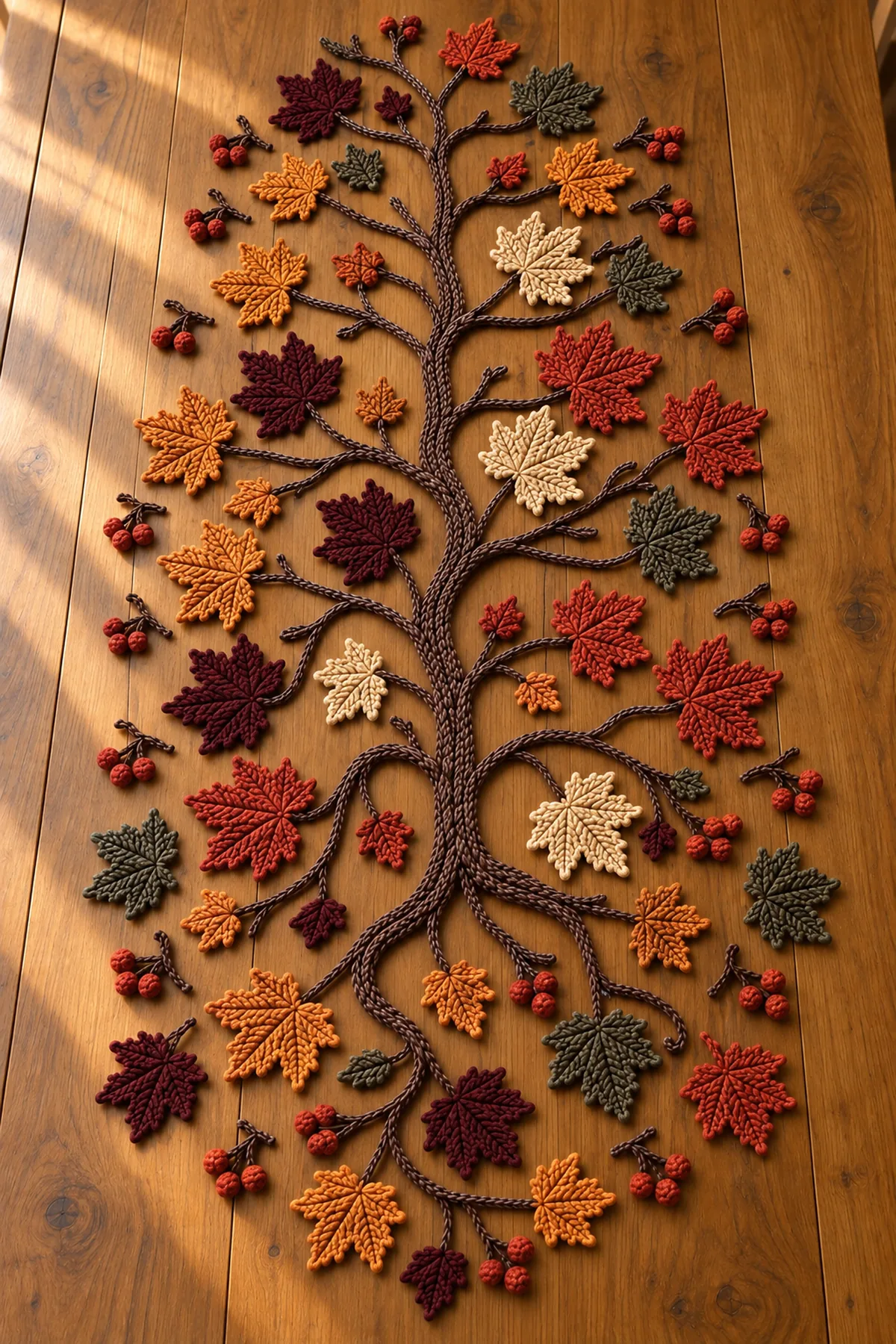
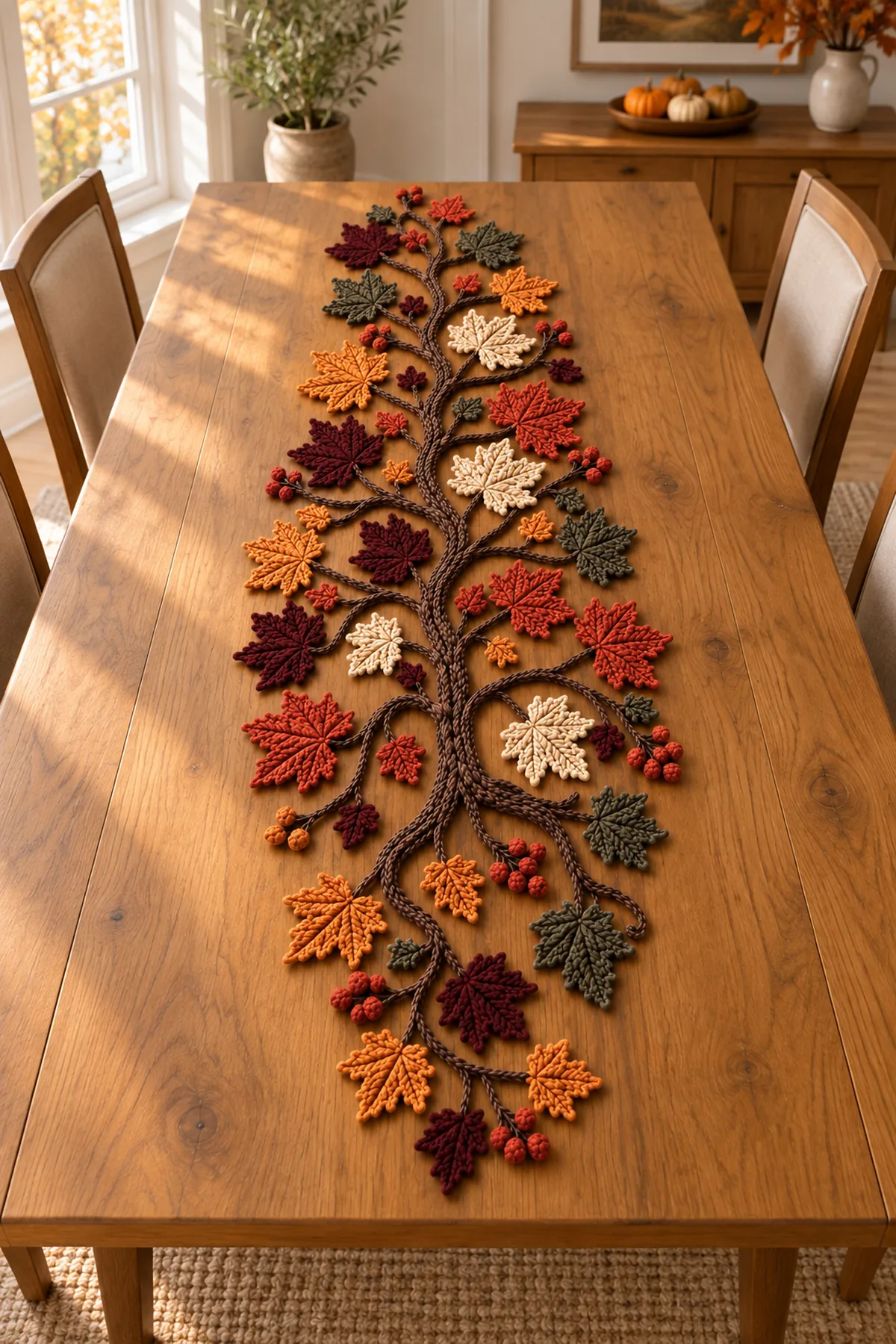
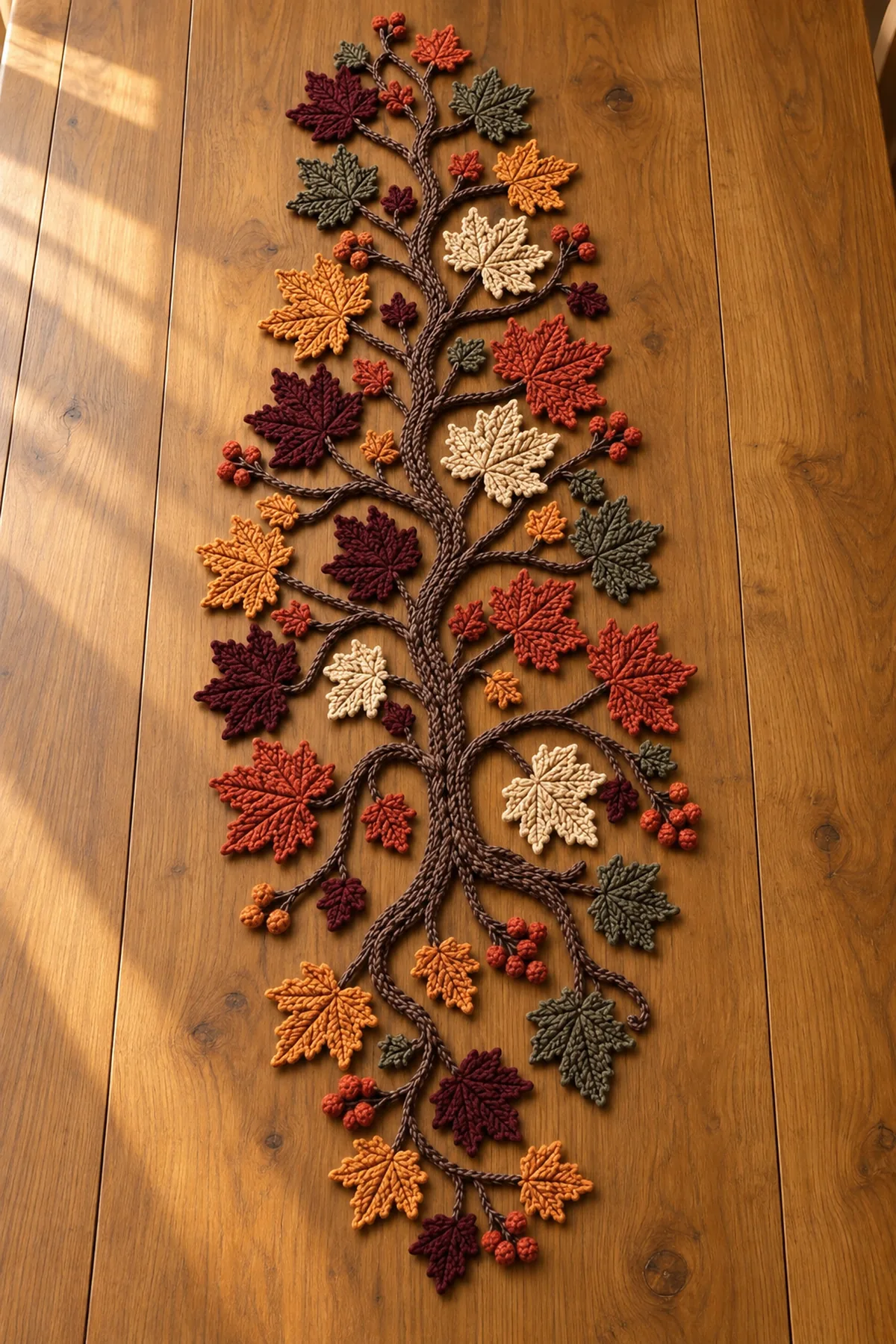
This Autumn Leaf Table Runner Free Crochet Pattern follows the supplied Reel design as an open botanical silhouette rather than a conventional rectangular runner. A thick, textured brown trunk travels through the full length, splitting into uneven side branches above and curling roots below. Thirty-nine pointed maple leaves in burgundy, burnt orange, golden ochre, warm cream, and deep olive are sewn at varied angles, while fifteen small berry clusters fill selected gaps. The wooden tabletop remains visible everywhere between the branches and motifs.
Thank you for reading this post, don't forget to subscribe!Crochet three narrow brown cords together into one raised central trunk, then branch them into paired and single offshoots that curve naturally to both sides. Form the lower roots from the same cords so the structure stays continuous. Make thirty-nine deeply lobed maple leaves in five autumn colors, working raised surface veins from stem to tip. Add fifteen three-berry bobble clusters, pin every component over a full-size tree-shaped template, and sew only at solid contact points. The finished runner is a freestanding crochet tree with no backing panel.
Why You’ll Love This Project
Every leaf is portable, and the limited motif vocabulary creates a detailed heirloom piece without repetitive rows across a large background. The brown cords provide a strong visual spine, the irregular branches keep the composition organic, and the mix of large and small maple leaves gives the photographed runner its layered woodland character.
Materials
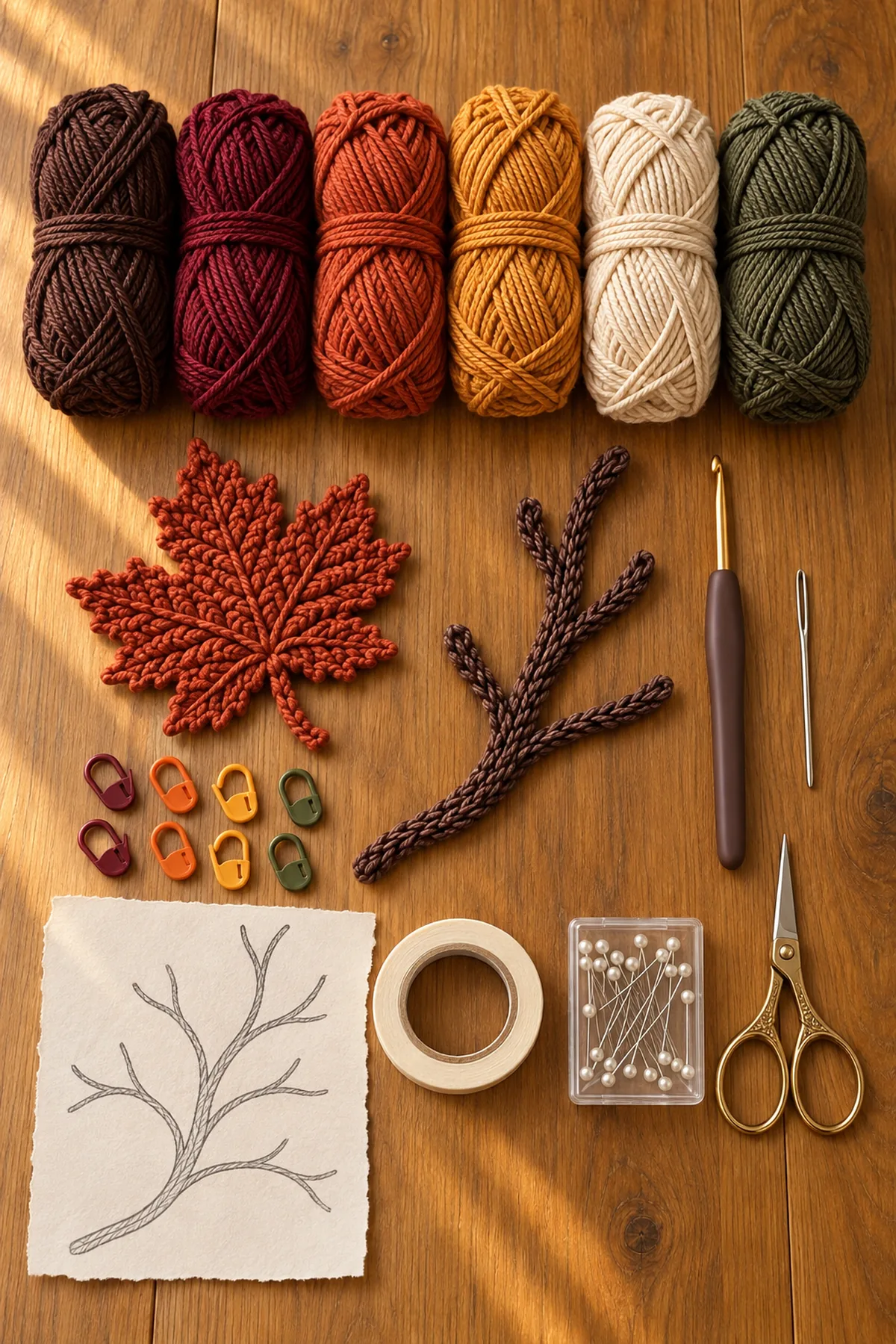
- About 520 yards dark chocolate-brown DK cotton for trunk, branches, stems, and roots
- About 150 yards burgundy DK cotton
- About 165 yards burnt-orange DK cotton
- About 135 yards golden-ochre DK cotton
- About 90 yards warm-cream DK cotton
- About 125 yards dark-olive DK cotton
- 3.5 mm crochet hook
- Yarn needle, sharp scissors, 40 locking markers, flexible measuring tape, large blocking mats, full-size paper template, and rustproof pins
Gauge, Measurements, and Planning
The first large maple leaf should measure about 4.5 inches wide after blocking, and a small leaf about 2.75 inches. The completed brown trunk-and-branch framework measures about 50 inches before leaves. Pin the entire structure to a 17-by-55-inch template; adjust branch curves before sewing rather than stretching leaves to fill space.
Make and wash a gauge swatch before beginning. Measure only after the swatch is completely dry. If the stitch width differs, change hook size rather than pulling the working yarn tighter. Keep a written count at the end of every section so the finished edges remain balanced and the assembly points line up.
Abbreviations and Special Stitches
- ch: chain
- sc: single crochet
- hdc: half double crochet
- dc: double crochet
- tr: treble crochet
- dtr: double treble crochet
- sl st: slip stitch
- st(s): stitch(es)
Special stitch guidance: Cord: work single crochet into the horizontal bar on the back of the previous row to create a firm braided strand. Cord split: continue selected live loops as separate branches without cutting the structural yarn. Maple point: graduate sc, hdc, dc, tr, and dtr toward the tip, ch 2, then mirror the stitches down the other side. Raised vein: surface-slip-stitch from the stem through the center and out toward each major lobe. Berry bobble: five unfinished dc closed together and locked with one chain.
Before You Begin
- The runner is an open tree silhouette; never add a rectangular, oval, lace, mesh, or fabric background.
- Make exactly thirty-nine maple leaves: ten burgundy, ten burnt orange, seven golden ochre, five warm cream, and seven dark olive.
- Make exactly fifteen berry clusters, each containing three small bobbles on short brown stems.
- Keep the trunk centered but make the side branches deliberately unequal and organic.
- The lower section must divide into visible curling roots, not end as a straight cord.
- Beginning chains do not count as stitches unless a step explicitly says they do.
Instructions
Crochet the Raised Brown Trunk and Branch Framework
Build one continuous organic tree spine with asymmetric offshoots and exposed tabletop between every branch.
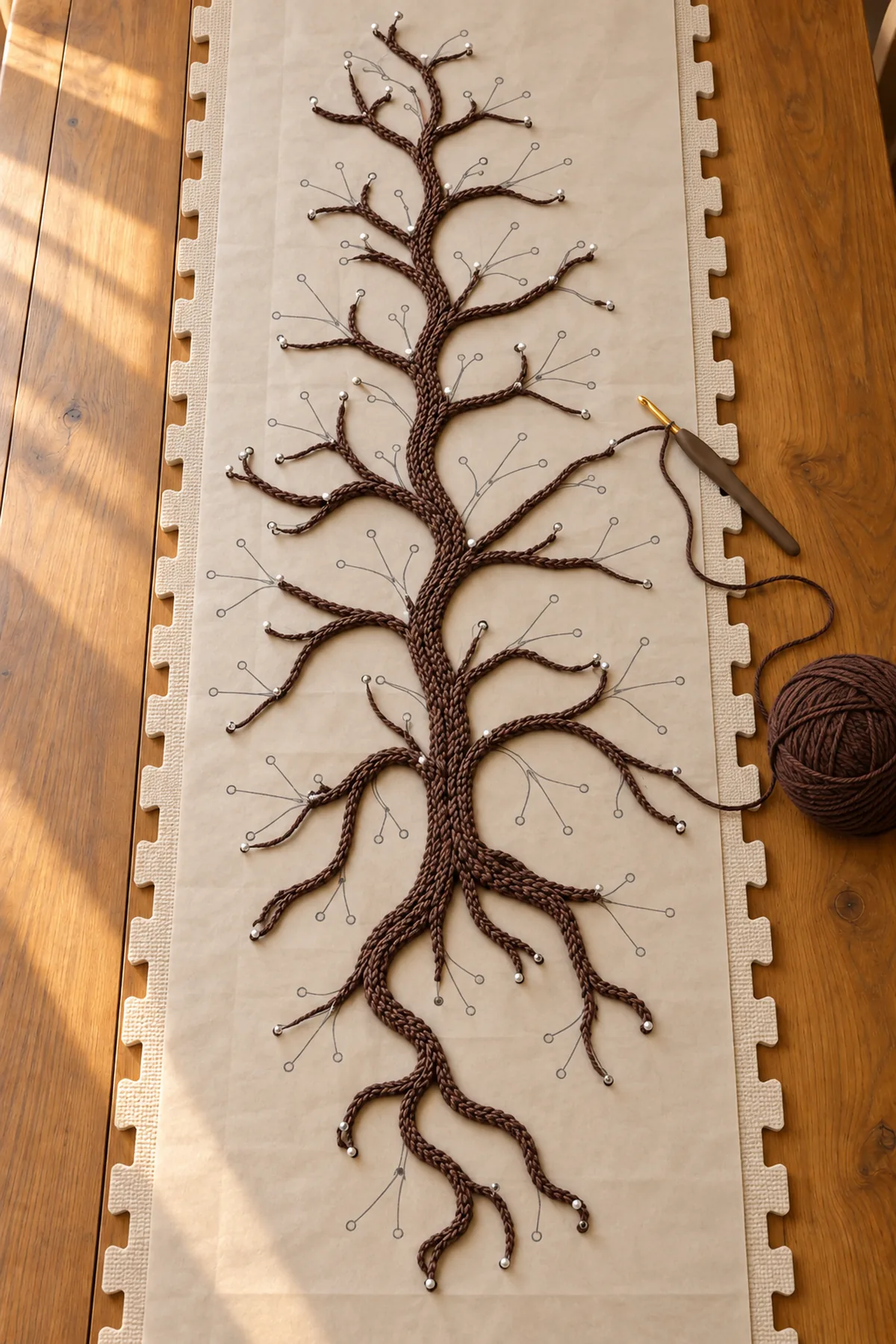
- With dark brown, ch 191. Beginning in the second chain, work 190 sc through the back bumps. (190 sts) Turn and work two cord rows into the back horizontal bars, maintaining 190 stitches in each row to create a firm raised trunk.
- Mark the lower 28 stitches for roots, the central 118 stitches for the main trunk, and the upper 44 stitches for the tapered crown. Along both sides, attach brown yarn at fourteen staggered marked positions and crochet branch cords 18 to 42 stitches long, varying every length.
- Split eight of the longer branches into two smaller forks. Curve the left and right branches in alternating directions; no pair should be perfectly mirrored. Add six short twig cords near the crown.
- At the lower end, divide the foundation into five root cords. Make the center root 34 stitches, two side roots 42 stitches, and two outer curling roots 50 stitches. Coil the two longest roots inward once before pinning.
- Surface-slip-stitch a second brown strand along the central 90 stitches and the base of the four thickest branches to copy the reference’s raised, braided bark texture. Pin the complete framework to a 50-inch tree-shaped centerline.
Make Thirty-Nine Deeply Lobed Maple Leaves
Use the exact five-color autumn palette and mix three sizes so the runner matches the dense photographed foliage.
- For each large leaf, ch 17 for the center spine. Starting in the second chain, work sl st, sc, hdc, dc, tr, dtr, tr, dc, hdc, sc, then form three graduated side lobes with chain-5, chain-4, and chain-3 arches on each side. Work a chain-2 point at every lobe tip and mirror the shaping back to the stem.
- For medium leaves, begin with ch 14 and use tr as the tallest stitch; form three lobes per side with chain-4, chain-3, and chain-2 arches. For small leaves, begin with ch 11 and use dc as the tallest stitch; form two lobes per side.
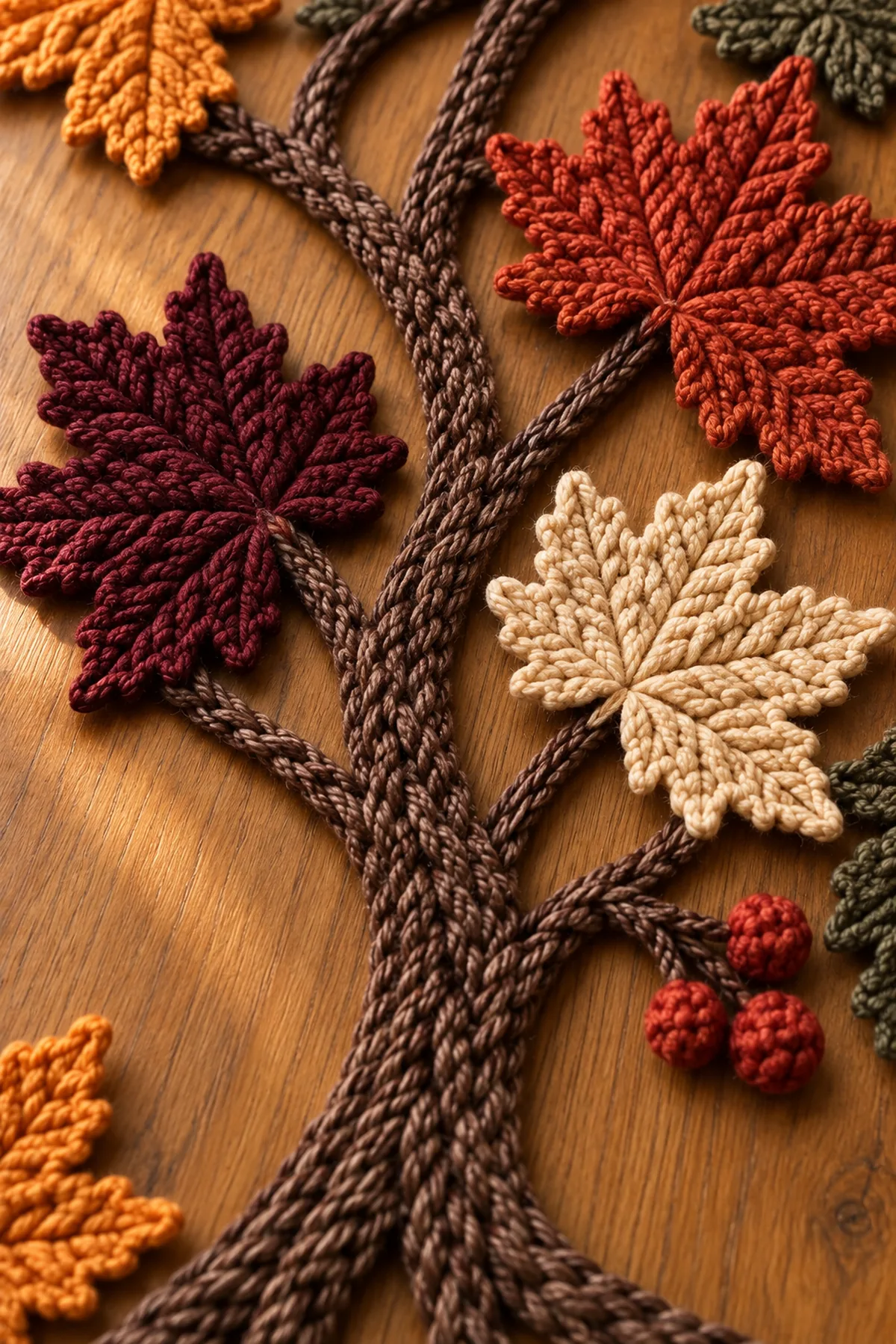
- Surface-slip-stitch a raised center vein from the stem to the top point. Add two diagonal vein lines toward every major side lobe, working loosely enough that the leaf remains flat.
- Make ten burgundy leaves, ten burnt-orange leaves, seven golden-ochre leaves, five warm-cream leaves, and seven dark-olive leaves. Across the thirty-nine total, make eighteen large, thirteen medium, and eight small leaves.
- Steam or wet-block every leaf separately, pinning all pointed lobes open. Leave a 12-inch sewing tail at each stem.
Crochet Fifteen Three-Berry Clusters
Small berry groups punctuate the branches without replacing or hiding any maple leaves.
- For each berry, make a magic ring, work five unfinished dc into it, yarn over and pull through all loops, then ch 1 to lock. Tighten the ring firmly.
- Make three berries for each cluster, using burgundy, rust, or ochre. Crochet three brown chain-5 stems, attach one berry to each stem, and gather the stem bases together.
- Make exactly fifteen clusters: six burgundy, six burnt-orange, and three golden-ochre. Keep every cluster compact, with the three berries individually visible.
- Block only the brown stems; do not flatten the rounded berry bobbles.
Copy the Reference Layout and Assemble
Arrange foliage in a long tree shape, keeping the trunk visible and preserving the open negative space of the supplied image.
- Pin the trunk vertically with the narrow crown at the top and five curling roots at the bottom. Confirm the silhouette measures about 17 by 55 inches and remains narrow enough for the center of a dining table.
- Place large leaves first: burgundy and olive near the upper crown, ochre and cream through the upper-middle branches, burgundy and rust across the broad center, and a balanced mixture around the lower branches and roots.
- Fill remaining branch ends with the thirteen medium and eight small leaves. Rotate every leaf independently; some point upward, others outward or downward. Do not arrange them in straight rows or color blocks.
- Distribute the fifteen berry clusters beside branch forks and small leaves, leaving the central brown trunk visible from top to roots. Keep several deliberate wood-visible gaps around the cream leaves and lower root curls.
- Sew each leaf stem along 1 to 1.5 inches of a solid branch cord. Add one discreet anchoring stitch beneath a large leaf only when needed. Secure berry clusters through their gathered brown stem bases.
- Mist-block the assembled runner on the full-size template. Shape all thirty-nine leaves, fourteen main branches, upper twigs, and five roots before allowing it to dry completely.
Assembly and Shaping
Pin the brown framework first, preserving the single central trunk, uneven branching crown, broad middle canopy, and five curling lower roots. Add the thirty-nine leaves by size before placing berries. Keep all five colors dispersed, retain open tabletop between motifs, and leave the braided brown trunk visible. The runner must never read as a rectangular cloth with appliques.
Lay every component on a flat surface before joining. Match the marked centers first, then divide each remaining edge into equal sections. Work through both layers with consistent tension and pause after each section to check that the fabric lies flat. This measured approach prevents twisting and keeps decorative details facing the intended direction.
Finishing
- Weave leaf tails through matching-color veins before trimming.
- Reinforce every fork, root split, and heavy large-leaf attachment from the back with brown yarn.
- Pin each maple lobe, branch curve, berry stem, and root curl to the full-size template.
- Allow the runner to dry completely, remove all pins, and tug-test every branch and applique before placing it on the table.
For a polished result, weave each tail through several same-color stitches, reverse direction once, and trim only after the fabric has been gently stretched. Block to the listed dimensions without flattening textured stitches. Inspect joins, borders, straps, and decorative pieces before the project is used or gifted.
Helpful Tips
- Photograph the complete pinned layout before sewing so no leaf position is lost.
- Use smooth cotton with strong stitch definition; fuzzy yarn hides the maple veins and braided bark.
- If a branch twists, steam it separately and pin the cord flat before attaching foliage.
- Keep the cream leaves widely separated so they act as bright focal points rather than a central stripe.
Good lighting and a contrasting stitch marker make counting much easier. If a section looks uneven, compare the current count with the previous checkpoint before continuing. Fixing one missed stitch early is faster than compensating later, and it preserves the measurements used by the assembly instructions.
Frequently Asked Questions
Can I add a solid backing?
No backing is used in the reference design. The exposed tabletop between the branches and leaves is essential to the tree silhouette.
Can I make fewer leaves?
You can, but it will not match this design. The photographed composition uses a dense canopy, represented here by exactly thirty-nine maple leaves and fifteen berry clusters.
Why do my maple leaves curl?
Check that mirrored sides contain the same stitch heights, then wet-block every lobe and vein before assembly.
Conclusion
One raised brown trunk, fourteen asymmetric branches, five curling roots, thirty-nine deeply lobed maple leaves, and fifteen berry clusters create the same open autumn-tree table runner shown in the supplied Reel image. Careful template assembly keeps the botanical silhouette long, airy, and structurally faithful without introducing a background panel or unrelated motifs.
Printable Crochet Pattern Card
Project: Autumn Leaf Tree Table Runner
Skill level: Advanced Intermediate Hook: 3.5 mm Yarn: DK
Finished size: Approximately 17 by 55 inches after blocking
Card Materials
- About 520 yards dark chocolate-brown DK cotton for trunk, branches, stems, and roots
- About 150 yards burgundy DK cotton
- About 165 yards burnt-orange DK cotton
- About 135 yards golden-ochre DK cotton
- About 90 yards warm-cream DK cotton
- About 125 yards dark-olive DK cotton
- 3.5 mm crochet hook
- Yarn needle, sharp scissors, 40 locking markers, flexible measuring tape, large blocking mats, full-size paper template, and rustproof pins
Card Instructions
- Crochet the Raised Brown Trunk and Branch Framework: Create one 190-stitch raised trunk, fourteen staggered branches with eight forks, six crown twigs, and five curling roots.
- Make Thirty-Nine Deeply Lobed Maple Leaves: Crochet exactly thirty-nine veined maple leaves: 10 burgundy, 10 rust, 7 ochre, 5 cream, and 7 olive in three sizes.
- Crochet Fifteen Three-Berry Clusters: Make fifteen compact clusters, each with three rounded berries on short brown stems.
- Copy the Reference Layout and Assemble: Pin the open tree framework, place all 39 leaves and 15 berry clusters asymmetrically, sew through solid stems, and block to 17 by 55 inches.
Finish: Check every count, weave in all ends, block to measurement, and inspect each join.